Revelation 3:1-6
1 And to the angel of the church in Sardis write: ‘The words of him who has the seven spirits of God and the seven stars. I know your works. You have the reputation of being alive, but you are dead.
2 “Wake up, and strengthen what remains and is about to die, for I have not found your works complete in the sight of my God.
3 Remember, then, what you received and heard. Keep it, and repent. If you will not wake up, I will come like a thief, and you will not know at what hour I will come against you.
4 Yet you have still a few names in Sardis, people who have not soiled their garments, and they will walk with me in white, for they are worthy.
5 The one who conquers will be clothed thus in white garments, and I will never blot his name out of the book of life. I will confess his name before my Father and before his angels.
6 He who has an ear, let him hear what the Spirit says to the churches.’
The Lydian Empire built the city of Sardis around 700 B.C. on a narrow plateau fifteen hundred feet above sea level (about thirty-five miles southeast of Thyatira). Because the Lydians built the town in a mountainous region, it was a natural citadel. 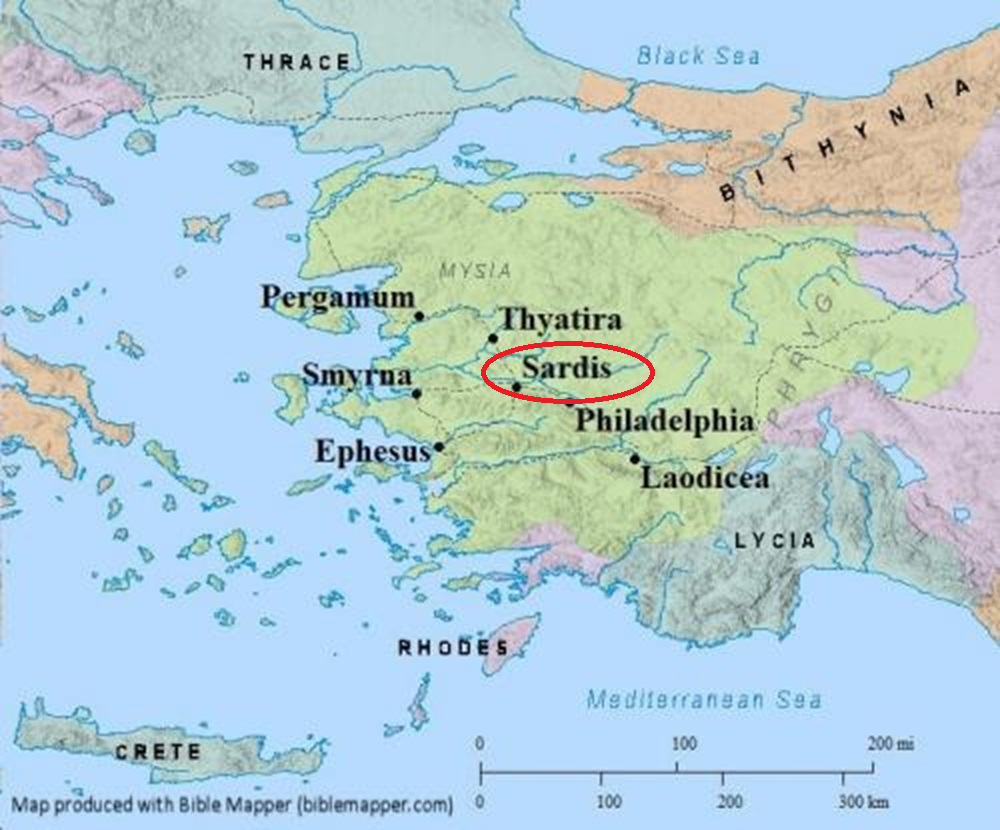 It was the capital of the Lydian Empire. It was conquered by the Persians in 550 BC, then by the Greeks in 334 BC, and later by the Romans around 130 BC. Where it remained as an important city.1 The wealth of Sardis came from the fertile farmland outside the city, the textile industry, and the Pactolus river, which provided water and contained gold dust.2
Sardis was home to many famous writers, poets, and philosophers, including Aesop, the fabled writer, and Herodotus, the father of historical writing.3 The nearby mountains were dotted with gold mines, thus making the city the monetary capital of the region. The patron deity, Cybele, was believed to be the mother of all gods and the mistress of life. The Romans built a temple for the goddess Artemis and a large bath-gymnasium complex. An earthquake hit the city in A.D. 17, causing tremendous damage. When the city was destroyed by an earthquake in 17 CE, the emperor Tiberius awarded no less than ten million sesterces for its reconstruction, and told the Sardisans that they did not have to pay taxes for five years. A temple to Tiberius was built during the rebuilding of Sardis.4
Revelation 3:1
And to the angel of the church in Sardis write: ‘The words of him who has the seven spirits of God and the seven stars. I know your works. You have the reputation of being alive, but you are dead.
1a To the angel of the church of Sardis write. The Greek word "aggelos" (Strong's G32, GK# 34) can be translated as angel or messenger.5 We know from various accounts in the Bible that angels were used numerous times as messengers from God. Are these messengers angelic or human? They could easily be either one, and I'm not sure it matters. However, in the book of Revelation, aggelos almost always refers to angelic beings rather than human messengers. In the letter to Sardis, "aggelos" is mentioned twice, once in verse 1 and then again in verse 5. Verse 5 is clearly referring to angelic beings. It is doubtful that the context would change. In my opinion, the aggelos in verse 1 is also an angelic being. Regardless of what you believe, the message is more important than the messenger.
When the New Testament was first written (in Koine Greek) there were no punctuation marks.6 Ancient Greek required the reader to use context and grammatical knowledge to determine phrasing.7 Why the lesson in ancient Greek? It is because the wording of this phrase can give the false impression that the letter is written to the angel. The lack of commas (no punctuation) in ancient Greek makes it easy to come to this conclusion. This opening phrase is actually a command to the angel to dictate what he is about to hear. Look what happens when I add a comma to the phrase: To the angel of the church in Sardis, write. The command is to the angel of the church in Sardis. What is the command? Write. What is he going to write? He will write down the words that are contained in verses two through six. The angel appears to have acted as a stenographer, writing down the words Christ dictated. The angel was receiving instructions to accurately transcribe (write down) what Jesus told him and then deliver that letter to the church. The letter was not written to the angel; it was transcribed (written) by the angel.
1b … the words of him who has the seven spirits of God.. The ESV translates the Greek phrase "tade legei" ("these say" as "The words." A more modern phrase might be "This is what he who has the seven spirits of God says." However it gets translated, this portion of the verse sets up where this letter is coming from. John may be the author, but the words are coming straight from Jesus. This phrase gives the letter divine authority.
The number seven tends to represent, or be a symbol of, completeness, or perfection.8 A reference is made in Rev. 1:4 to seven Spirits who are in front of God's throne. The word Spirits is capitalized, which means they are part of, and are in essence, God himself. (Keep in mind that when the New Testament was being written, ancient Greek only used upper-case letters. The lower-case letters were not introduced until about 950 AD. Technically, writers capitalized every word.) The word Spirits is the Greek word “pneuma” (Strong’s G4151, G/K G4460), which means spirit, breath, or wind.9 Perhaps the seven Spirits are personifications of God, or maybe they represent seven of His powers.
In Isaiah 11:2, the prophet speaks of the Spirit of the Lord resting upon the Messiah. Perhaps these are the seven Spirits. Let's take a look at Isaiah 11:2: And the Spirit of the Lord shall rest upon him, the Spirit of wisdom and understanding, the Spirit of counsel and might, the Spirit of knowledge and the fear of the Lord. Now let's take this verse apart.
1) Spirit of the Lord (YHWH)
2) Spirit of wisdom
3) Spirit of understanding
4) Spirit of counsel
5) Spirit of strength
6) Spirit of knowledge
7) fear of the Lord
If the Spirit of the Lord, wisdom, understanding, counsel, strength, knowledge, and the fear of the Lord, are the seven Spirits in front of the throne, what we are seeing is perhaps, a sevenfold ministry of the Holy Spirit.
1c … and the seven stars. Revelation 1:20 explains that the seven stars represent the seven angels (messengers) of the seven churches, which are named in Rev 1:11. Once again, we must ask the question: Are these angelic messengers or human messengers? My opinion is that they are angels; your opinion may be that they are human messengers. Once again, I'm not sure it matters. What matters is that the messengers, or stars, have an important task: conveying the words of Jesus to their respective churches. The messenger could easily be either angelic or someone in a leadership role.
1d … I know your works. The word works (Strong’s G2041, G/K G2240) means “work, deed, action, task.” It covers an extremely wide range of occupations, trades, skills, and activities.10 This indicates two things: one is that Sardis was an active church. They were doing things, having programs, and reaching out to the surrounding community. This was a church “on the go,” a lively church, a flourishing church. It was a church with a good reputation. It was a church that was in good standing with the community. Many churches today don't even have any works or activities. They are not doing anything for God. People show up for Sunday morning services, and the church does nothing for the rest of the week. Sound familiar?
Another thing the phrase "I know your works" indicates is that God is always watching. This aspect of God is something that we hardly ever think about. God watches and knows our deeds. He doesn't only know what we do, He knows why we do. He knows us better than we even know ourselves. We should be encouraged by this because even when it seems like no one notices the things we do, God does.
1e … You have the reputation of being alive, but you are dead. A reputation is what other people commonly think (opinion) and say about you11 (or the church in Sardis in this case). The church in Sardis had a good reputation for being alive and active. It was probably a church that people wanted to be a part of. The church was doing things. How many churches do you know that have a reputation for being alive and active? How many churches do you know of that are dead and inactive? Which are there more of? Sardis sounds like the type of productive church that we would want to attend. But the church in Sardis has a problem, a big problem. But you are dead.
The church had a name and a reputation for being alive; unfortunately, that name and reputation were with the world. Their reputation did not come from God. They were so busy doing things and trying to entertain and please the world that they forgot what the church is all about. They had stopped doing their work and activities for God. In all their activity, they were too busy to notice that the church had died. They were too busy trying to convince each other that they were "Spiritual" to notice that they were dead. All the work and activity meant nothing. All the church activity was worthless. Why? It is because the church was really dead. The church is going through the motions, but they are not measuring up to God's standard of Holiness. What looked alive and active to man was dead as far as God was concerned. They thought they were very active for the Lord, but they were not intimate with the Lord. God looks at the heart and judges our motives. He watches to see why we do what we do.
Perhaps the ice cream social was more important than the altar call. I imagine that the preaching was no longer focused on God and repentance, but had become watered down into a social gospel. Perhaps many people attended the church because the message did not offend them. Perhaps (dare I use the word) sin was never mentioned. The church may have had a good reputation in the city, but God was not impressed.
Reverlation 3:2
Wake up, and strengthen what remains and is about to die, for I have not found your works complete in the sight of my God.
2a Wake up, and strengthen what remains and is about to die. The phrase wake up, means to be watchful, awake, attentive, vigilant, to see clearly, and to carefully examine.12 This phrase would have been very poignant to the church at Sardis, who knew their city's history. Back in 546 BC, Cyrus’ Persian army slipped into the city at night while the Sardian army was asleep.13 It happened again in 214BC, the city was captured at night by Antiochus the Great, with his army, while the city slept.14 The call to wake up is a call from God that resounds through the ages to the church today. This may be especially true if you are in a church that seems alive and active! We cannot afford to fall asleep in the Sonlight. Wake up, before it is too late. Wake up, while you still can. This begs the question: how do I wake up?
The first thing we have to do is search our hearts to see if we are awake. Are our works and activities (if we are doing any) done for the glory of Christ, or for our own glory? Whom do we want to get the credit for what we are doing, Jesus, or ourselves? Not only must we wake up, but we must stay awake and be watchful. We must keep a careful guard of our hearts.
2b… strengthen what remains and is about to die. They had already lost so much, and so little remained. What was it in the church at Sardis that still remained? It was their deeds and their works that still remained. The church was commanded: to strengthen what remains. This command implies that what remains is weak and desperately needed to be strengthened.
The implication is that Sardis’s works, deeds, and actions were not being done for the glory of God, but for the glory of the church, or perhaps even for personal gain. The congregation’s works and deeds were performed to give their church and themselves a good reputation. The church would have to change its focus and work for God in order to strengthen the works that remained. The works, deeds, and actions that remained were about to die. The church was in serious trouble, and they did not even know it! This seemingly active and thriving church was heading straight for the spiritual grave. If they don't get their act together and straighten out their priorities, the few deeds that are left will wither and die. Now is the time for the church to get on its knees and seek the Lord. Only by prayer and repentance could Sardis strengthen the things that remain.
2c … for I have not found your works complete in the sight of my God. I find it a bit unnerving that my works and deeds could be incomplete or imperfect in the sight of God. There must be a way to prevent this from happening. Let me share with you what I found in the scriptures. James 1:25 says, “But one who looks intently at the perfect law, the law of liberty, and abides by it, not having become a forgetful hearer but an effectual doer, this man shall be blessed in what he does.” God will bless our works and deeds if we abide in His perfect law of liberty (the word of God). If His word is in our hearts and we do as His word commands, He will bless our works. Our works will be complete in His sight.
Hebrews 10:23-24 says “Let us hold fast the confession of our hope without wavering, for He who promised is faithful; and let us consider how to stimulate one another to love and good deeds.” These verses show our responsibility to one another: we need to encourage one another to love and good deeds. We should also encourage each other to keep our priorities straight. We should make sure that we do our good deeds for the glory of God. The church in Sardis was not doing this. Their deeds and works were therefore incomplete in the sight of God. The church was essentially wasting its own time.
Revelation 3:3
Remember, then, what you received and heard. Keep it, and repent. If you will not wake up, I will come like a thief, and you will not know at what hour I will come against you.
3a Remember, then, what you received and heard. The word remember (in various forms) is used over 200 times in the Old Testament. God continually told his people to remember the things he had done for them. The word what should actually be interpreted as “in what way, or how.”15 God wanted the church in Sardis to remember in what way they had received and heard His word. In 1st Thessalonians 1:5, Paul writes, “for our gospel did not come to you in word only, but also in power and in the Holy Spirit and with full conviction.” I believe that Sardis had this same experience that Paul was referring to. The power of God had convicted them of their sins. Sadly enough, they had forgotten why they had once accepted Jesus as their Lord and Savior.
3b … keep it, and repent. The word keep (Strong’s G5083, G/K G5498) means “to keep watch over, guard, obey, observe.”16 Just as the guards on Sardis’s walls failed to keep watch over the city, so the church failed to keep watch over their hearts. The gospel message that had saved their souls had become yesterday’s news. They were supposed to keep the memory of what (and how) they had received and repent of their backsliding. God wanted them to look at their hearts and see the wrong attitudes and motives. God wanted them to repent. You and I must also search our hearts and repent of any attitude or motive that would be displeasing to God. Repenting is something we sometimes need to do daily.
Repentance denotes a change in life, causing a complete readjustment of thoughts and attitudes. While the modern emphasis tends to focus on sorrow, remorse, or contrition, the Greek word repent (Strong’s G3340, G/K G3566) carries the idea of completely changing your attitude, thoughts, and behaviors concerning the demands of God for right living.17 You can discern a person’s repentance by their conduct. If there is no change in conduct, then there was no repentance. Whether the focus is on attitude or behavior depends on the context. Jesus wanted the Christians at Sardis to completely change their thinking and orientation about their indifference to the gospel.18
3c … If you will not wake up. The church was receiving a wake-up call, and God was about to tell them what would happen if they did not heed His warning. God has given us free will. Having free will means that we can choose to ignore God. God lets us know what the consequences are if we choose to ignore Him. We have no excuse if we choose to go against God. We cannot say “I didn't know,” because we did. Just as God is warning Sardis, He also warns us today. What exactly is His warning?
3d … I will come like a thief, and you will not know at what hour I will come against you. A professional thief can sneak into your house while you are home, and you will not know that he is there. The best time for him to sneak into the house is when you are asleep because you are not expecting him. A thief tends to avoid a home when people are awake and moving around. A thief comes uninvited, without your consent, and without your knowledge. The image God is giving is that, like the thief, He will come unannounced and without warning, and the church will not be ready.
The imagery of a thief is, in all actuality, a very scary thought. The picture presented here is one of judgment. The church may not be ready and will be judged for being unready. A church that is spiritually asleep is totally unacceptable to God. We cannot be doing His work if we are asleep. We will not be ready for His coming if we are not paying attention. Even now, the question is still valid. Are we as a church ready? Or will He find us unprepared? God will not announce beforehand what hour He will come. He wants and expects us to be ready. He wants and expects us to be spiritually awake. Spiritual slumber is not an option for us. The consequences are dire. God wants us to be ready, and that is why He has given us a warning. The church would be wise to heed it.
Revelation 3:4
Yet you have still a few names in Sardis, people who have not soiled their garments, and they will walk with me in white, for they are worthy.
4a Yet you have still a few names in Sardis, people who have not soiled their garments. I find it amazing that among all these “dead” church goers, there are a few people who were truly alive Christians. The word few means puny, a small number of.
19 The word emphasizes how small the number of people is. The first question that came to my mind was this: why did they stay? Why did they stay in a spiritually dead church? I think I would have left and found an “alive” church to attend. I feel a little guilty about that. These few people in Sardis have stronger character than I do. They have more patience than I do. Their walk with God is closer than mine. They saw through all the hypocrisy and were not affected by it. They saw all the “dead” people around them and continued to be a living example. If only I had that kind of strength.
There were a few people in the church at Sardis who had not soiled their garments. What does that mean? What does it mean to soil your garment? We know that when we get saved, the blood of Jesus washes away our sin. The blood of Jesus makes our garment clean and white. In order for us to soil our garments after they have been washed clean, we have to remain in sin. This lack of clean garments means that most of the people in the church in Sardis were “worldly Christians” or “carnal Christians.” They were living in sin while claiming to be Christians. They were going to church and playing the game. They were fooling everyone except God.
Another option is that they were never saved in the first place. Many commentators believe this to be true (I do not). If they were never saved, then their “garments” were never washed white. How do you make something dirty that was never clean? This thought is truly frightening. If this option is true, then the church had lost the mission of bringing people to Christ. The church would had to have become a place where sin was not mentioned. It would have to be a place where people could be comfortable in their fallen state of sin. The message of salvation was probably not being preached. It would have been a church where people could go to feel good about themselves. It would have been a place where they would not have to hear about and deal with that “sin” issue.
However, if it is possible for people who have never accepted Jesus as their personal Lord and Savior to have unsoiled garments, then they did it on their own. After achieving their own salvation, their garments are now soiled with the sin that they themselves somehow cleansed themselves from. Now you have a theological conundrum that destroys the message of the gospel. It is my opinion that a person’s garments can only be washed clean by the blood of Jesus.
4b they will walk with me in white, for they are worthy. These few people would walk with God in their white garments. God had found them to be worthy. Why? Were these people perfect? Not likely. They were human after all, just like you are, just like I am. These people kept their garments from becoming soiled. How did they keep their garments from becoming soiled? The same way you and I do: by confessing our sin to God. 1 John 1:9 says, “If we confess our sins, He is faithful and righteous to forgive us our sins and to cleanse us from all unrighteousness.” Confessing our sin to God and seeking his forgiveness is key to keeping our garments clean. Confession and forgiveness are how God finds us worthy. If we continue to confess our sins to God, He will keep our garments clean, and someday we will walk with Him.
Revelation 3:5
The one who conquers will be clothed thus in white garments, and I will never blot his name out of the book of life. I will confess his name before my Father and before his angels.
5a The one who conquers will be clothed thus in white garments. The ESV changed the word order slightly and, in the process, inadvertently changed some of the context. The wording should be: The one who conquers thus will be clothed in white garments. Where you place the word thus makes a big difference in the context of the verse. The word thus (Strong’s G3779, G/K G4048) means in this manner, in the same way.
20 In what manner, in what way, are we conquerors, or overcomers? The people who serve God, confess their sins, and live for Him will be conquerors. The word conquers means to conquer, overcome, or be more than victorious.
21 It is often translated as “overcomer.” Conquering, or overcoming, is not a certainty but rather an aspiration each individual should pursue. However, it is a victory gained by an active faith fed through fellowship with the Lord.22
The Savior’s words are never to them (a collective group) who overcome, but to the one (the individual) who overcomes. Victory is not a collective right but an individual attainment. Clearly, the promises to the overcomers are rewards for obedience to the commands of the Lord to the Church.23 He who is victorious will be clothed in white garments. Only those who overcome, who are victorious, will wear the white garments. The “ordinary” priests in the Old Testament wore white linen garments (Exodus 28:39, and 39:26). No priest, neither ordinary priest nor the High Priest himself, was fit to serve in the tabernacle unless he was wearing the priestly garments. Unless our garments are clean, white, and not soiled with sin, we will not be able to serve God in the heavenly temple.
5b … I will never blot his name out of the book of life. It is a wonderful promise for Christians who overcome. The only people whose names are written in the book of life are those who have accepted Jesus as their personal Lord and Savior. Here’s the conundrum: What about those who don’t overcome? We know that there are people who have not turned to Christ in repentance and faith, who have rejected Him as their Lord and Savior. Tragically, their names will not be found there, and they will enter eternity with no hope of Heaven.24 The Bible solemnly warns, “If anyone’s name was not found written in the Book of Life, he was thrown into the lake of fire” (Revelation 20:15).
5c I will confess his name before my Father and before his angels. The word confess means to acknowledge.
25 In the context of this verse, the word confess is a legal term. It’s like standing before a judge and “confessing” that you will tell the truth, whole truth, and nothing but the truth. Jesus is going to make the “confession” before God the Judge, that you are indeed someone who has accepted Jesus as your Lord and Savior and have followed his commands. In other words, when we stand before God, Jesus will stand next to us and will acknowledge (to the court) that we served Him faithfully and will he will publicly recognize that faithfulness to the God the Father (the Judge). The other interesting point is that Jesus not only acknowledges us before God, but also before the heavenly angels. (The word aggelos in this verse more than likely does not refer to earthly messengers.)
Revelation 3:6
He who has an ear, let him hear what the Spirit says to the churches.
The phrase he who has an ear qualifies everyone who will listen and obey. It is a phrase Jesus often used when speaking in parables. Whenever Christ says, "He who has an ear, let him hear," He calls for people to pay careful heed. It's another way of saying, “Listen up! Pay close attention! What I said was important!” Those who have “ears to hear” allow the Word to bear fruit to the glory of God. It is up to the hearer to decide whether to take the Word seriously and try to understand and obey it. The church is called to pay close attention and seek God’s wisdom regarding the written Word. Only a few are willing; the rest have ears but do not have “ears to hear” (Matthew 7:13–14, 24–27).
Application
We as a church need to examine our spiritual garments and ensure they not soiled with sin. Does God see your spiritual garments as clean or soiled? Are you overcoming sin, or is it overcoming you? It is not too late for us, provided we act now. Today is the day to repent; tomorrow is not promised to us.
Would you like information on how to become a Christian?
Touch the button below for Steps to Salvation
✝ Salvation
Have a question or comment about “Sardis?”
Touch the button below to send Steven P. Wickstrom an e-mail:
E-mail
To print “Sardis” click the button below to download the PDF file.
Print
Footnotes
[1] Joshua J. Mark, “Sardis,” World History Encyclopedia, September 27, 2022, accessed March 11, 2026, https://www.worldhistory.org/sardis/. ↩
[2] Titus Kennedy, “Sardis,” Drive Thru History, accessed March 11, 2026, https://drivethruhistory.com/sardis/?srsltid=AfmBOopUmjQjq2Nltc4rPBrLBMB16fvfVUamFae57Ey0juqjSwxLmM0T. ↩
[3] Cameron Deggin, Uncovering Secrets of Sardis and Exploring the Ancient City - Property Turkey, April 7, 2023, accessed March 11, 2026, https://www.propertyturkey.com/blog-turkey/uncovering-secrets-of-sardis-and-exploring-the-ancient-city. ↩
[4] Jona Lendering, “Sardes,” Livius, accessed March 11, 2026, https://www.livius.org/articles/place/sardes/. ↩
[5] Moises Silva, New International Dictionary of New Testament Theology and Exegesis, 2nd ed. (Grand Rapids, MI: Zondervan, 2014), 1:120. ↩
[6] William D. Mounce, Basics of Biblical Greek Grammar, ed. Verlyn D. Verbrugge, 3rd ed. (Grand Rapids, MI: Zondervan, 2009), 12. ↩
[7] Emily Snow, “Why Ancient Greeks Wrote without Spaces or Punctuation,” TheCollector, accessed April 3, 2026, https://www.thecollector.com/scriptio-continua-ancient-greek-writing/. ↩
[8] Elaine Goodfriend, “Seven, the Biblical Number,” TheTorah.Com, accessed March 11, 2026, https://www.thetorah.com/article/seven-the-biblical-number. ↩
[9] Bill Mounce, “Πνεῦμα,” Billmounce.Com, accessed March 11, 2026, https://www.billmounce.com/greekvocabulary/%CF%80%CE%BD%CE%B5%E1%BF%A6%CE%BC%CE%B1. ↩
[10] Moen, Skip. “Paycheck.” Hebrew Word Study | Skip Moen. Last modified March 11, 2012. Accessed March 12, 2026. https://skipmoen.com/2012/03/paycheck/. ↩
[11] Cambridge Dictionary Online, s.v. "reputation," accessed March 20, 2026, http://search.eb.com/bol/topic?eu=69437&sctn=1 ↩
[12] Spiros Zodhiates, The Complete Word Study: New Testament (Chattanooga, TN: AMG Publishers, 1991), 418. ↩
[13] Editorial Staff, “Sardis Ancient City - Manisa: Artichaeology / Articles on History,” Articles History Archaeology, accessed March 16, 2026, https://www.artichaeology.com/sardis-ancient-greek-city. ↩
[14] Joshua J. Mark, “Polybius’ Capture of Achaeus and Fall of Sardis,” World History Encyclopedia, October 4, 2022, accessed March 13, 2026, https://www.worldhistory.org/article/2076/polybius-capture-of-achaeus-and-fall-of-sardis/. ↩
[15] Bill Mounce, “Πῶς,” Billmounce.Com, accessed March 16, 2026, https://www.billmounce.com/greek-dictionary/pos. ↩
[16] Spiros Zodhiates, The Complete Word Study: New Testament (Chattanooga, TN: AMG Publishers, 1991), 1380. ↩
[17] Moisés Silva, New International Dictionary of New Testament Theology and Exegesis, 2nd ed., vol. 4, 5 vols. (Grand Rapids, MI: Zondervan, Credo Reference, 2019), 3:291. ↩
[18] Grant Richison, “Revelation 3:3,” Bible Exposition Commentary, accessed March 16, 2026, https://versebyversecommentary.com/1998/11/10/revelation-33/. ↩
[19] Joseph H. Thayer, A Greek-English Lexicon of the New Testament (Grand Rapids, MI: Baker Book House, 1977), 442. ↩
[20] Skip Moen, “Paycheck,” Hebrew Word Study | Skip Moen, accessed March 12, 2026, https://skipmoen.com/2012/03/paycheck/. ↩
[21] Verlyn D. Verbrugge, New International Dictionary of New Testament Theology (Grand Rapids, MI: Zondervan, 2004), 387. ↩
[22] J. Hampton Keithley, “Revelation - Appendix 3: Who Are the Overcomers?,” Revelation - Appendix 3: Who Are the Overcomers? | Bible.org (Bible.org, February 2, 2009), last modified February 2, 2009, https://bible.org/seriespage/revelation-appendix-3-who-are-overcomers. ↩
[23] Zane C. Hodges, Grace in Eclipse, Redencion Viva, Dallas, TX, 1987, p. 108-109. ↩
[24] Billy Graham. “What Is The Book of Life and Does It Really Exist? - The Billy Graham Library Blog.” The Billy Graham Library. Last modified February 22, 2022. Accessed March 18, 2026. https://billygrahamlibrary.org/what-is-the-book-of-life-and-does-it-really-exist/. ↩
[25] Moisés Silva, New International Dictionary of New Testament Theology and Exegesis, 2nd ed., vol. 4, 5 vols. (Grand Rapids, MI: Zondervan, Credo Reference, 2019), 3:506. ↩
© 02 Apr 2026 by Steven P. Wickstrom, all rights reserved. Click the button below for more information about the copyright.