Revelation 3:7-13
7 “And to the angel of the church in Philadelphia write: ‘The words of the holy one, the true one, who has the key of David, who opens and no one will shut, who shuts and no one opens.
8 ‘I know your works. Behold, I have set before you an open door, which no one is able to shut. I know that you have but little power, and yet you have kept my word and have not denied my name.
9 Behold, I will make those of the synagogue of Satan who say that they are Jews and are not, but lie—behold, I will make them come and bow down before your feet, and they will learn that I have loved you.
10 Because you have kept my word about patient endurance, I will keep you from the hour of trial that is coming on the whole world, to try those who dwell on the earth.
11 I am coming soon. Hold fast what you have, so that no one may seize your crown.
12 The one who conquers, I will make him a pillar in the temple of my God. Never shall he go out of it, and I will write on him the name of my God, and the name of the city of my God, the new Jerusalem, which comes down from my God out of heaven, and my own new name.
13 He who has an ear, let him hear what the Spirit says to the churches.”
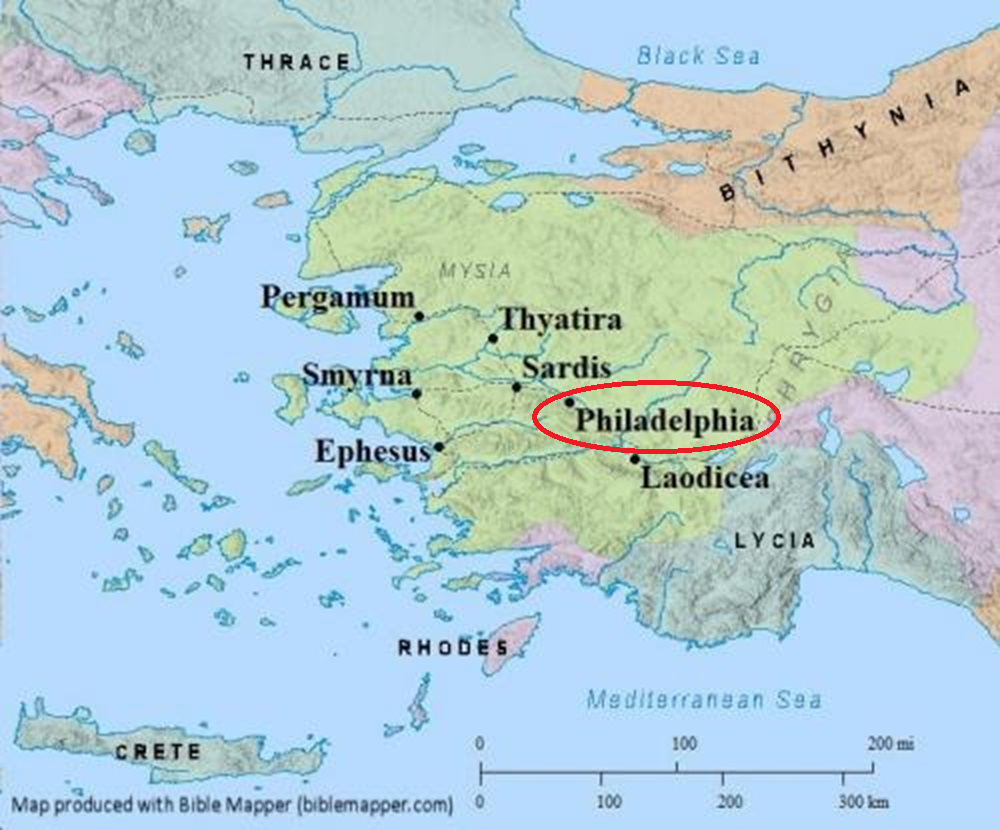 Philadelphia was a relatively young city. It was founded in 189 BC by King Eumenes II of Pergamon. He named the city for the love of his brother and successor, Attalus II Philadelphus.1 The city was in the Lydian region of ancient Anatolia. After Attalus III (r. 138–133 B.C.E.) bequeathed the Pergamene kingdom to the Romans in 133 B.C.E., Philadelphia came under Roman control.2 The city was located in an agricultural area where farming was the only industry. It was not an important city, but it did have many temples. The city was also famous for its grapes and wine; its chief deity was Dionysus, the god of wine in Greek mythology.3
Unfortunately, the founders built Philadelphia on a fault line, and it subsequently suffered from many earthquakes. An earthquake destroyed the city in 17 AD, and the emperor Tiberius sent funds to rebuild the city. He graciously informed the Philadelphians that they did not have to pay taxes for five years. To honor him, the people built a temple to Tiberius during the rebuilding of Philadelphia.4 Following the rebuilding of the city, the inhabitants renamed it to “Neoceasaria,” which means “Caesar’s new city.”5 After the death of Tiberius, the name changed back to Philadelphia. Remains of the city gate, facing east, have been discovered and appear to have been rebuilt during the Byzantine Period. This “door” would have been the entrance to the city.6
Reverlation 3:7
And to the angel of the church in Philadelphia write: ‘The words of the holy one, the true one, who has the key of David, who opens and no one will shut, who shuts and no one opens.
7a To the angel of the church in Philadelphia write. The Greek word "aggelos" (Strong's G32, GK# 34) can be translated as angel or messenger.7 We know from various accounts in the Bible that angels were used numerous times as messengers from God. Are these messengers angelic or human? They could easily be either one, and I'm not sure it matters. However, in the book of Revelation, aggelos almost always refers to angelic beings rather than human messengers. In my opinion, the aggelos in verse 18 is an angelic being. Regardless of what you believe, the message is more important than the messenger.
When the New Testament was first written (in Koine Greek) there were no punctuation marks.8 (Koine (pronounced coin-ay) Greek was the universal dialect spoken throughout the Greco-Roman world.) Koine Greek required the reader to use context and grammatical knowledge to determine phrasing.9 Why the lesson in ancient Greek? It is because the wording of this phrase can give the false impression that the letter is written to the angel. The lack of commas (no punctuation) in ancient Greek makes it easy to come to this conclusion. This opening phrase is actually a command to the angel to dictate what he is about to hear. Look what happens when I add a comma to the phrase: To the angel of the church in Philadelphia, write. The command is to the angel of the church in Philadelphia. What is the command? Write. What is he going to write? He will write down the words that are contained in verses 7 through 13. The angel appears to have acted as a stenographer, writing down the words Christ dictated. The angel was receiving instructions to accurately transcribe (write down) what Jesus told him and then deliver that letter to the church. The letter was not written to the angel; it was transcribed (written) by the angel.
7b The words of the holy one, the true one, who has the key of David. In this section of the verse, Jesus is presenting his authority to the church. Let’s break this up into three segments: 1) holy, 2) true, and 3) key of David.
1) Jesus notified the church that he is holy. The word “holy” means “consecrated, set apart.” The idea of holiness extends beyond a mere absence of impurity; it captures the inherent sanctity and perfection (wholeness, completeness, absoluteness) of God. The holiness of Christ is directly related to his divinity.
2) Jesus notified the church that he is true. The word “true” means “true, genuine, authentic.” There is no falsehood in Jesus. He only speaks truth. Everything that Jesus says is true, and, therefore, there is no reason to doubt anything that he says.
3) Jesus notified the church that he had the key of David. This “key” is first mentioned in Isaiah 22:22, which states, “And I will place on his shoulder the key of the house of David. He shall open, and none shall shut; and he shall shut, and none shall open.” To understand this “key,” we must go back and examine this passage in Isaiah.
Isaiah 22:20-24 (The Lord lifts up Eliakim instead of Shebna)
20 In that day I will call my servant Eliakim the son of Hilkiah,
21 and I will clothe him with your robe, and will bind your sash on him, and will commit your authority to his hand. And he shall be a father to the inhabitants of Jerusalem and to the house of Judah.
22 And I will place on his shoulder the key of the house of David. He shall open, and none shall shut; and he shall shut, and none shall open.
23 And I will fasten him like a peg in a secure place, and he will become a throne of honor to his father's house.
24 And they will hang on him the whole honor of his father's house, the offspring and issue, every small vessel, from the cups to all the flagons.
There are several things to look at in these verses:
a. Eliakim, the son of Hilkiah: Mentioned in passages like 2 Kings 18:18 and Isaiah 36:3, Eliakim was another assistant to King Hezekiah. He should not be confused with Eliakim, the son of Josiah, who was a puppet king established by Pharaoh (2 Kings 23:34).
b. My servant: What a glorious title for Eliakim! Both Shebna and Eliakim were servants of Hezekiah. Shebna's heart, however, was directed towards selfish ambition and glory. Eliakim's heart, on the other hand, was turned towards the Lord.
c. Eliakim, the son of Hilkiah: The place of Eliakim before Hezekiah is somewhat obscure in the Scriptures. While he is mentioned in six passages, the only description of him is that he was over the household (2 Kings 18:18, 37, and Isaiah 36:3, 22). But Eliakim was famous in heaven! He shall be a father to the inhabitants of Jerusalem and to the house of Judah.
d. I will clothe him with your robe and bind your sash on him; I will commit your authority into his hand: The Lord would take the office and authority of the unfaithful Shebna and give it to Eliakim instead. God will get His work done! If a Shebna is unfaithful, the Lord will remove him from his office, strip him of his authority, and give it to another.
e. The key of the house of David I will lay on his shoulder: Because Eliakim is the Lord’s servant, the Lord will give him great authority. In that day and age, the chief royal steward would have the large master key of the palace fastened to the shoulder of his tunic. The key was a picture and demonstration of the authority of the chief steward. Here, the LORD gives Eliakim the authority to open and shut the palace as the LORD’s representative, which no man can oppose. If the steward shut the door, no one could get in to see the king.11
Jesus stated that he has the key of David. He controls who gets to go in and see God. Jesus is also letting the church know that He is the fully responsible steward of the church.
7c … who opens and no one will shut, who shuts and no one opens. Since Jesus is the door, the only way into heaven is through him (John 10:9). When we accept Jesus as our personal Lord and Savior, he opens the door of salvation for us. For those who reject Jesus, however, the door of salvation remains closed. The purpose of verse one is to give the letter divine authority.
Revelation 3:8
I know your works. Behold, I have set before you an open door, which no one is able to shut. I know that you have but little power, and yet you have kept my word and have not denied my name.
8aI know your works. What are works? The word translated as works means “anything done, or to be done; a deed, works, or actions.”12 Jesus Christ is the foundation of our salvation, faith is the instrument of our salvation, and works are the fruit (evidence) of our salvation.13 The Westminster Confession of Faith, chapter 16, (used by numerous Protestant denominations) lists nine benefits of good works; here are six:14
1) They manifest our gratitude to God for the gift of his son (Col 2:6).
2) Bolster our assurance of faith (1 John 2:1-6).
3) Are a means of encouraging other Christians toward greater acts of love (Hebrews 10:24).
4) Cause us to adorn the doctrine of God in our lives.
5) Silence the enemies of Biblical Christianity. (1 Peter 2:15).
6) Glorifies God by displaying His work of love in our lives (John 15:8-11).
In telling the church at Thyatira that he is aware of their works, Jesus is demonstrating his intimate knowledge of both the lives and their actions. It can be either reassuring or disturbing that God watches everything we do.
8b Behold, I have set before you an open door, which no one is able to shut. The "open door" symbolizes opportunities for ministry and evangelism, as well as access to the kingdom of God.15 In the New Testament, Paul often refers to open doors as opportunities for spreading the Gospel (1 Corinthians 16:9, 2 Corinthians 2:12, Colossians 4:3). Once Jesus opens that door, no man can shut it. His statement is an incredible promise; however, we must choose to walk through the open door.
8c I know that you have but little power. The ESV left out a very important word at the beginning of 8c, and that word is because, or since. This portion should actually read “because you have little power.” The word power – dunamis (Strong’s G1411, G/K G1539) refers to miraculous power, as in signs and wonders.16 The church in Philadelphia had a small effective capability for miraculous work. It was not entirely lacking, but it was present only in a small measure. It is because of that reason that Jesus was holding the door (of ministry) open.
Many versions of the Bible (e.g., NIV, NLT, HCSB, CEV, ISV) translate dunamis as “strength.” The word can mean strength in the sense of performing miraculous works, transforming hearts, and unstoppable life-giving power.17 Translating dunamis as “strength” can, unfortunately, lead people to think that Philadelphia was a “weak” church. When we contrast the church at Philadelphia with the majority of churches in the United States, we can see a distinct difference. The church in Philadelphia was only performing a small amount of miracles. The majority of churches in the United States are performing no miracles. This information places the church in Philadelphia way ahead of the majority of churches in the United States. It is better to have little (small amount of) power than no power.
8d yet you have kept my word and have not denied my name. In a time when the other churches were following false teachings, Philadelphia maintained doctrinal purity and continued to obey Christ's commands. What does it mean to deny Jesus’ name? The word deny means the same thing in Greek that it does in English: “to disown, renounce, reject.”18 In the context of this verse, the word deny is used of followers of Jesus who, for fear of death or persecution, deny that Jesus is their master, and desert his cause.19 The church in Philadelphia had remained loyal to Christ, not renouncing their faith even under pressure.
Revelation 3:9
Behold, I will make those of the synagogue of Satan who say that they are Jews and are not, but lie, behold, I will make them come and bow down before your feet, and they will learn that I have loved you.
9a Behold, I will make those of the synagogue of Satan. The word “synagogue” is a Greek word (Strong’s G4864, GK# 5252), which means “assembly.”20 The synagogue was the center of the Jewish religious community: a place of prayer, study, education, social and charitable work, as well as a social center.21 The early church (for the most part) avoided using the word synagogue to describe itself. Instead, they used the Greek word “ekklesia,” which also translates as “assembly.”22 However, in James 2:2, the meeting of Christians is referred to as a synagogue. The word synagogue, therefore, can refer to either a Christian or Jewish assembly.
Another option is also possible. The word "synagogue” could refer to any place where "religious" people assemble. Please remember that even idol worshipers are religious. The people who worshiped the emperors were also very religious. Philadelphia had many temples where religious devotees assembled. The Greeks and Romans were very religious people, but their zeal was not for God. My point is that we should not automatically assume that "synagogue" refers only to a Jewish assembly. It could easily refer to Christians, or Gentiles, or any assembly. The remainder of the verse will reinforce the idea that this “synagogue” is not Christian or Jewish.
The word “Satan” is the Greek word “Santana” (Strong’s G4567, GK# 4928), which means “accuser or adversary.”23 The word is not actually a Greek word, but was transliterated24 from the Hebrew word. The word was borrowed from the Old Testament. Rather than using the Greek word (antidikos) for either accuser or adversary, Jesus specifically used “santana.”. The Hebrew scribes did not capitalize the word satan, nor was it used as a name. The advantage of using the Hebrew "satan" over the Greek word "antidikos" is that "satan" implies evil intentions, whereas "antidikos" does not. I believe for that reason, the Hebrew word for accuser/adversary is used instead of the Greek word. Also, the Greek definite article (tou), which is translated as “the,” is in front of santana. The word satan is, therefore, not a proper noun. It is not being used a name, but as a descriptor. It should not be capitalized. The phrase “synagogue of Satan” could literally be translated as the “assembly of the accusers or assembly of adversaries.”25 The people who are slandering the Christians are, more than likely, a group of Gentiles (masquerading as Jewish people) with evil intentions. Since this portion of the verse is referring to people falsely claiming to be Jews, it would make more sense to use the phrase “assembly of the accusers.”
9b … who say that they are Jews and are not, but lie. “Jews” is an interesting word. There is a Greek word for “Israelite” (Strong’s G2475), but Jesus did not use it in this statement. The Greek word used here is “loudaious” (pronounced ee-oo-dah-yos), which translates as “Judeans.”26 The word “Jew” did not enter the English language until around 1275 AD.27 Many times in the New Testament, the word “Jews” is specifically referring to the religious leadership.28 The Gospel writers often referred to large groups of Israelites as “crowds” or “people.” The use of the word “Jews” (especially in the Gospels) may have been a way to let the readers know that it was mainly the religious leaders who opposed Christ. If that same thought process is being used in this verse, then it lets us know that “Jews” refers to religious leaders. But then we immediately encounter a problem.
The problem we encounter is the phrase “who say that they are Jews and are not.” The best way to look at this phrase is to take the phrase at face value, without reading anything into it. These people were not actually Jewish but were only pretending (falsely claiming) to be Jews. There is a strong possibility that these people are not just stirring up trouble for the Christians, but they may have been hoping for a backlash against the Jewish population as well. The phrase makes it very clear that it was not anyone from the Jewish population making trouble for the Christians.
9c … behold, I will make them come and bow down before your feet, and they will learn that I have loved you. This portion of the verse suggests a future vindication for the faithful believers in Philadelphia. The imagery of bowing down is reminiscent of Old Testament prophecies in which nations would acknowledge Israel's God ( Isaiah 60:14). It signifies a reversal of roles, where those who persecuted the church will recognize its divine favor. This act of bowing is an acknowledgment of wrongdoing and a gesture of respect. Whoever these Gentile unbelievers are, they will be forced (by God) to admit that God cares for and loves his church.
Revelation 3:10
Because you have kept my word about patient endurance, I will keep you from the hour of trial that is coming on the whole world, to try those who dwell on the earth.
10a Because you have kept my word about patient endurance This phrase acknowledges the faithfulness of the church in Philadelphia. The phrase patient endurance simply means perseverance. It can describe someone who keeps on going when it would be easy to get tired and quit. This perseverance is a recurring theme in the New Testament, as seen in James 1:12 and Hebrews 10:36, emphasizing the importance of steadfastness in the Christian walk while going through persecution.
10b … I will keep you from the hour of trial. This phrase suggests Godly intervention to shield believers from a specific period of trial. Most modern theologians view the "hour of trial" as a future time of tribulation, possibly linked to eschatological events described elsewhere in Revelation. The church in Philadelphia would not have had this perspective. They would have assumed it would happen during their lifetime.
When the Roman Empire collapsed in 476 AD, the Eastern portion continued as the Byzantine Empire. It was a mere shadow of the Roman Empire. The Byzantine Empire ruled from Constantinople and contained all 7 of the churches in Revelation. While the Western portion of the Roman Empire burned, Philadelphia, and the Eastern portion were spared. They did not endure the hour of trial that the Western Empire endured as it fell. When the Byzantine Empire fell to the Turks of the Ottoman Empire in 1453 AD, Philadelphia was one of the few cities they did not destroy.
10c … that is coming on the whole world. The church in Philadelphia would not have interpreted the phrase the whole world the same way we do. For them, the whole world consisted of the Roman Empire, and only the Roman Empire.31 Over time, as the concept of a planet came into being, the phrase slowly “evolved” to mean all of humanity and the planet. It is important to understand that the church in Philadelphia did not have this definition of the phrase. They would have interpreted this section of the verse to read “that is coming on the whole Roman Empire.” For them, it meant that God would judge the Roman Empire, but God would shield them from that judgment.
10d … to try those who dwell on the earth. The word earth (Strong’s G1093, G/K G1145) did not mean “planet” back then. In the context of this verse, it means “land, country, region, territory.”32 It denotes land as that which yields vegetation and produce, or land as supporting a political entity: a country or region.33 As such, the early church would have interpreted this word as supporting a political entity, or in other words, the Roman Empire. God was going to keep you from the hour of trial that is coming on the Roman Empire, to try those who live in the Roman Empire.
Revelation 3:11
I am coming soon. Hold fast what you have, so that no one may seize your crown.
11a I am coming soon. The word soon means exactly what you think it does, “swiftly, quickly, without delay, soon, suddenly (by surprise).”34 How, then, should we interpret the significance of the term “soon” in verse 11? To a considerable extent, this depends on the view we take of the book as a whole. The church in Philadelphia probably would have taken “soon” quite literally. Thus, God would complete the prophetic events within a very few years. 2000 years later, we no longer define “soon” the way the Philadelphians did. We now see the time factor as quite elastic. This view of time is a very elementary principle of Bible interpretation. The Bible frames some prophecies in language that makes it appear as if the events have already occurred. Use of that language emphasizes the certainty of God’s plan (cf. Isaiah 9:6).35
11b Hold fast what you have. The phrase hold fast is used 23 times in the book of Revelation. What did they have? In verses 8 and 10, we saw that they had kept His word, they had not denied His name, and they had kept His command to persevere. This verse is a “keep on keeping on” moment. Essentially, it means to keep doing what you’re doing.
11c … so that no one may seize your crown. The word seize means “to take, receive, obtain,” but the nuance is to take away or to remove.36 It implies the possibility of losing one's reward through negligence of their relationship with Jesus. It also begs the question: who would take away their crown? Vance Havner (evangelist during the 60’s, 70’s and 80’s) once said, “Never forget that the man most likely to steal your crown is yourself. ‘Keep thy heart with all diligence, for out of it are the issues of life. You are in no greater danger from anyone or anything than from yourself.”37 It does not mean the believers would lose their salvation, only that they would lose their rewards (which is not necessarily a good thing).
Revelation 3:12
The one who conquers, I will make him a pillar in the temple of my God. Never shall he go out of it, and I will write on him the name of my God, and the name of the city of my God, the new Jerusalem, which comes down from my God out of heaven, and my own new name.
12a The one who conquers, I will make him a pillar in the temple of my God. The word conquers (Strong’s G3528, G/K 3771) is also translated as “overcomer” in many versions of the Bible. The word means “to conquer, overcome, or be more than victorious.”38 Conquering, or overcoming, is not a certainty but rather an aspiration each individual should pursue. However, it is a victory gained by an active faith fed through fellowship with the Lord.39 The Savior’s words are never to them (a collective group) who overcome but to the one (the individual) who overcomes. Victory is not a collective right but an individual attainment. Clearly, the promises to the overcomers are rewards for obedience to the Lord's commands to the Church.40 Jesus will make that person a pillar in the temple of my God. He has rebuilt us into a temple for himself. In that day and age, builders constructed temples of pillars that supported horizontal beams that supported the roof.41 The more pillars they had, the bigger the temple could be. It seems obvious that God is building a huge temple. This imagery was probably potent to a church in a city that was constantly rebuilding from natural disasters. Unlike the temples in Philadelphia, nothing can ever destroy God's temple.
12b Never shall he go out of it, and I will write on him the name of my God, and the name of the city of my God, the new Jerusalem, which comes down from my God out of heaven, and my own new name. After an earthquake destroyed a temple, the old, fallen pillars had to be removed and new ones erected in their place. The fact that God’s pillars will never leave the temple reflects the eternal security and unbroken fellowship with God that believers will experience in the new creation. Writing God's name on the believer signifies ownership, identity, and belonging. In biblical times, names held significant meaning and often represented character and authority. Just as the residents changed Philadelphia's name to Neocaesaria to reflect what Caesar had done for them, so having the names of God written on believers reflects what God has done for us. In addition, the builders of temples in the Greek and Roman era often chiseled their names into the stones.42 When God writes his name on his “pillars,” it lets everyone know who the Master Builder is. One interesting aspect of this verse is that Jesus has a new name. Jesus did not tell us what this name is, and apparently, we do not need to know it at this time.
Revelation 3:13
He who has an ear, let him hear what the Spirit says to the churches.
It is possible to hear the words of Jesus and not hear what he is saying. The phrase he who has an ear qualifies everyone who will listen and obey. It is a phrase Jesus often used when speaking in parables. Whenever Christ says, "He who has an ear, let him hear," He calls for people to pay careful heed. It's another way of saying, “Listen up! Pay close attention! What I said was important!” Those who have “ears to hear” allow the Word to bear fruit to the glory of God. It is up to the hearer to decide whether to take the Word seriously and try to understand and obey it. The church is called to pay close attention and seek God’s wisdom regarding the written Word. Only a few are willing; the rest have ears but do not have “ears to hear” (Matthew 7:13–14, 24–27).
Application
God opened the door for evangelism and ministry for the church in Philadelphia. This door is still open for the modern church to take advantage of. Are we utilizing this open door? The church in Philadelphia was a church of little power, but not a church of no power. Are we, as a church, operating in the miraculous power of God, or are we a “no power” church? The church in Philadelphia kept the word of God. Are we staying true to the word of God, or are our Biblical standards eroding? Do we have a Biblical worldview, or have we become tolerant of sin?
Would you like information on how to become a Christian?
Touch the button below for Steps to Salvation
✝ Salvation
Have a question or comment about “Philadelphia?”
Touch the button below to send Steven P. Wickstrom an e-mail:
E-mail
To print “Philadelphia” click the button below to download the PDF file.
Print
Footnotes
[1] Nicholas Pangere, “Ancient Philadelphia: Exploring the Basilica of St. John in Alaşehir,” Nomadic Niko, accessed March 24, 2026, https://nomadicniko.com/turkey/ancient-philadelphia/. ↩
[2] Fant, Clyde E, and Mitchell G Reddish, 'Philadelphia', A Guide to Biblical Sites in Greece and Turkey (New York, 2003; online edn, Oxford Academic, 12 Nov. 2020), https://doi.org/10.1093/oso/9780195139174.003.0043, accessed 24 Mar. 2026. ↩
[3] Orcum Erdogan, “On the History of Religions in Philadelphia in Lydia until the End of Late Antiquity,” Mediterranean Journal of Humanities 4, no. 1, 2014 (2014): 171–197, https://doi.org/10.13114/MJH.201416431. ↩
[4] Jona Lendering, “Sardes,” Livius, accessed March 11, 2026, https://www.livius.org/articles/place/sardes/. ↩
[5] Editorial Team, “Philadelphia History,” Ephesus Travel Guide, accessed April 1, 2026, https://www.ephesustravelguide.com/blog/philadelphia-history. ↩
[6] Titus Kennedy, “Philadelphia,” Drive Thru History, accessed March 24, 2026, https://drivethruhistory.com/philadelphia/?srsltid=AfmBOopGALY8LdRFYcDNNOvW-2SHWkjXiot3iHufLj0cGOJIuayO-CS5. ↩
[7] Moises Silva, New International Dictionary of New Testament Theology and Exegesis, 2nd ed. (Grand Rapids, MI: Zondervan, 2014), 1:120. ↩
[8] William D. Mounce, Basics of Biblical Greek Grammar, ed. Verlyn D. Verbrugge, 3rd ed. (Grand Rapids, MI: Zondervan, 2009), 12. ↩
[9] Emily Snow, “Why Ancient Greeks Wrote without Spaces or Punctuation,” TheCollector, accessed April 3, 2026, https://www.thecollector.com/scriptio-continua-ancient-greek-writing/. ↩
[10] Daniel Esparza, “A Closer Look at Our Understanding of the ‘Holy,’” Aleteia, accessed March 25, 2026, https://aleteia.org/2023/12/21/a-closer-look-at-our-understanding-of-the-holy/. ↩
[11] David Guzik, “Enduring Word Bible Commentary Isaiah Chapter 22,” Enduring Word, accessed March 25, 2026, https://enduringword.com/bible-commentary/isaiah-22/. ↩
[12] Bill Mounce, “Ἔργον,” Billmounce.Com, accessed December 15, 2025, https://www.billmounce.com/greek-dictionary/ergon. ↩
[13] John Tweeddale, “Good Works and the Christian Life,” Ligonier Ministries, accessed December 15, 2025, https://learn.ligonier.org/articles/good-works-christian-life. ↩
[14] “The Westminster Confession of Faith,” Menlo Security, n.d., accessed December 15, 2025, https://safe.menlosecurity.com/doc/docview/viewer/docN3A4B269E9DE4e1e6b2ca6be4635d4015783c8e9465fdca76feadf4757bc8e3cb31d551703635, 27. ↩
[15] Grant Richison, “Revelation 3:3,” Bible Exposition Commentary, accessed March 16, 2026, https://versebyversecommentary.com/1998/11/10/revelation-33/. ↩
[16] Spiros Zodhiates, The Complete Word Study: New Testament (Chattanooga, TN: AMG Publishers, 1991), 486. ↩
[17] Editorial Staff, “What Is the Meaning of the Greek Word Dunamis in the Bible?,” CompellingTruth.Org, accessed March 30, 2026, https://www.compellingtruth.org/dunamis-meaning.html. ↩
[18] Spiros Zodhiates, The Complete Word Study Dictionary: New Testament (Chattanooga, TN: Publishers, AMG, 1992), 254. ↩
[19] Joseph H. Thayer, A Greek-English Lexicon of the New Testament (Grand Rapids, MI: Baker Book House, 1977), 74. ↩
[20] Moises Silva, New International Dictionary of New Testament Theology and Exegesis, 2nd ed. (Grand Rapids, MI: Zondervan, 2014), 4:397. ↩
[21] Tracey R. Rich, “Synagogues, Shuls and Temples,” Judaism 101: Synagogues, Shuls and Temples (Judaism 101, n.d.), https://www.jewfaq.org/synagogues_and_temples. ↩
[22] Verlyn D. Verbrugge, New International Dictionary of New Testament Theology (Grand Rapids, MI: Zondervan, 2004), 171. ↩
[23] Spiros Zodhiates, The Complete Word Study Dictionary: New Testament (Chattanooga, TN: Publishers, AMG, 1992), 1282. ↩
[24] Transliterate means to change the letters from one language (such as Hebrew) into the corresponding letters of another language (such as Greek). For example, the Hebrew letter samekh (ס) (s in English) corresponds to the Greek letter sigma (σ) (s in English). ↩
[25] Eli -Lizorkin-Eyzenberg, “Synagogue of Satan,” Israel Bible Weekly (Israel Bible Weekly, February 10, 2020), last modified February 10, 2020, accessed December 12, 2022, https://weekly.israelbiblecenter.com/synagogue-satan/. ↩
[26] Spiros Zodhiates, The Complete Word Study Dictionary: New Testament (Chattanooga, TN: Publishers, AMG, 1992), 779. ↩
[27] Joseph A. Edelheit, “Why Are We Called Jews?: Parashat Vayigash,” Why Are We Called Jews? | Parashat Vayigash (World Union for Progressive Judaism (WUPJ), December 13, 2018), https://wupj.org/library/the-weekly-portion/10418/why-are-we-called-jews-parashat-vayigash/. ↩
[28] John M. Black, “The Book of John and ‘the Jews,’” The Jerusalem Post | JPost.Com, accessed October 13, 2025, https://www.jpost.com/christian-in-israel/history/the-book-of-john-and-the-jews-308397. ↩
[29] BillMounce, “Πῶς,” Billmounce.Com, accessed March 16, 2026, https://www.billmounce.com/greek-dictionary/pos. ↩
[30] John Bechtle, “Hupomone: Was Job Patient?,” Ezra Project, accessed March 31, 2026, https://ezraproject.com/hupomone-was-job-patient/. ↩
[31] Bill Mounce, “oikoumene,” Billmounce.Com, accessed March 16, 2026, https://www.billmounce.com/greek-dictionary/oikoumene. ↩
[32] Spiros Zodhiates, The Complete Word Study Dictionary: New Testament (Chattanooga, TN: Publishers, AMG, 1992), 367. ↩
[33] Editorial Team, “Γη: Abarim Publications Theological Dictionary (New Testament Greek),” Abarim Publications, September 29, 2016, accessed April 1, 2026, https://www.abarim-publications.com/DictionaryG/g/g-et.html. ↩
[34] Spiros Zodhiates, The Complete Word Study Dictionary: New Testament (Chattanooga, TN: Publishers, AMG, 1992), 1369. ↩
[35] Wayne Jackson, “What Is the Meaning of ‘Shortly Come to Pass’?,” Christian Courier, accessed March 31, 2026, https://christiancourier.com/articles/what-is-the-meaning-of-shortly-come-to-pass. ↩
[36] Moisés Silva, New International Dictionary of New Testament Theology and Exegesis, 2nd ed., vol. 4, 5 vols. (Grand Rapids, MI: Zondervan, Credo Reference, 2019), 3:81 ↩
[37] David Guzik, “Revelation Chapter 3.” Enduring Word. Last modified March 11, 2026. Accessed April 1, 2026. https://enduringword.com/bible-commentary/revelation-3/. ↩
[38] Verlyn D. Verbrugge, New International Dictionary of New Testament Theology (Grand Rapids, MI: Zondervan, 2004), 387. ↩
[39] J. Hampton Keithley, “Revelation - Appendix 3: Who Are the Overcomers?,” Revelation - Appendix 3: Who Are the Overcomers? | Bible.org (Bible.org, February 2, 2009), last modified February 2, 2009, https://bible.org/seriespage/revelation-appendix-3-who-are-overcomers. ↩
[40] Zane C. Hodges, Grace in Eclipse, Redencion Viva, Dallas, TX, 1987, p. 108-109. ↩
[41] Editorial Staff, “Above the Columns, What?,” YSMA, accessed April 1, 2026, https://www.ysma.gr/en/educational-actions/lets-learn-play-and-create/above-the-columns-what/. ↩
[42] Mark Milligan, “Inscriptions Reveal the Lives behind the Ancient Temples of the Middle East,” HeritageDaily, accessed April 1, 2026, https://www.heritagedaily.com/2026/01/inscriptions-reveal-the-lives-behind-the-ancient-temples-of-the-middle-east/156729. ↩
© 14 April 2026 by Steven P. Wickstrom, all rights reserved. Click the button below for more copyright information.