Revelation 3:14-22
14 “And to the angel of the church in Laodicea write: ‘The words of the Amen, the faithful and true witness, the beginning of God's creation.
15 ‘I know your works: you are neither cold nor hot. Would that you were either cold or hot!
16 So, because you are lukewarm, and neither hot nor cold, I will spit you out of my mouth.
17 For you say, “I am rich, I have prospered, and I need nothing,” not realizing that you are wretched, pitiable, poor, blind, and naked.
18 I counsel you to buy from me gold refined by fire, so that you may be rich, and white garments so that you may clothe yourself and the shame of your nakedness may not be seen, and salve to anoint your eyes, so that you may see.
19 Those whom I love, I reprove and discipline, so be zealous and repent.
20 Behold, I stand at the door and knock. If anyone hears my voice and opens the door, I will come in to him and eat with him, and he with me.
21 The one who conquers, I will grant him to sit with me on my throne, as I also conquered and sat down with my Father on his throne.
22 He who has an ear, let him hear what the Spirit says to the churches.’”
Laodicea was a town in the Lycus River valley in present-day Turkey. It was about 100 miles east of the port city of Ephesus. 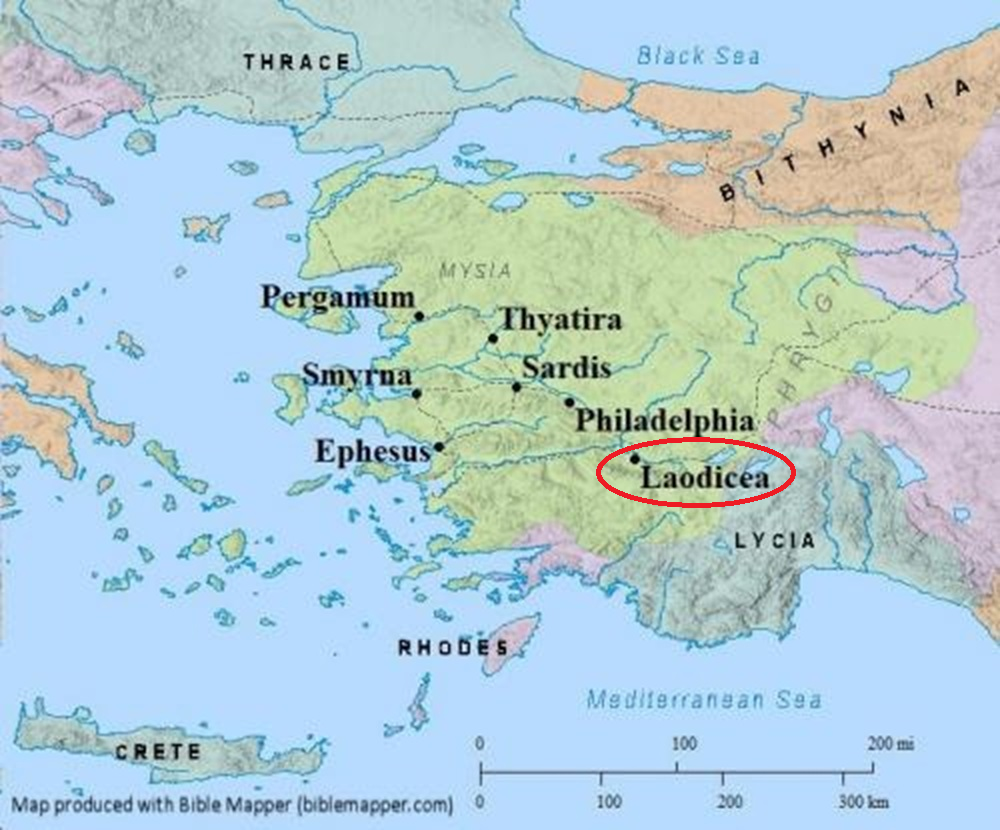 Uniquely situated on a large flat-topped hill, the town was protected from flooding in the spring when the snow melted off the nearby mountains. Archeology has revealed that the first settlement was built around 3000 BC.1 The fertile valley contained pastures with large flocks of sheep. “The city was at the crossroads of north-south traffic between Sardis and Perga and east-west from the Euphrates to Ephesus. Laodicea quickly became a rich city, rich enough to be able to rebuild itself without outside help after the destructive earthquake of 60 A.D. The city's reputation was for its money transactions and the good quality of raven-black wool grown in the area.”2 The black wool, spun into dark yarn, was added to yarn dyed in other colors and made some very intricately patterned colored clothing, which sold for a high price in Rome. Tunics manufactured in Laodicea, called trimata, were so well-known that the city had the nickname of Trimataria.3 As a result of the textile industry, the Laodiceans were wealthy people.
Laodicea also had a medical school for training people to become doctors. Two doctors from Laodicea were so famous that their names appeared on the city’s coins (Zeuxis and Alexander Philalethes). Even Aristotle spoke of the medicines from Laodicea that supposedly helped with eyesight and hearing. People came from all over the empire to purchase this medicine. The famous "Phrygian powder" was also produced in Laodicea.4 It was a medicine used for treating eye diseases. Local resources of zinc and alum became the basis for the production of eye ointments, known as kollyria, also sold by merchants from Laodicea.5 The powder would be mixed with water to give it a paste-like consistency and then applied to the eyes.

Six miles to the north, the town of Hierapolis sat on the top of the cliffs overlooking the valley. Hierapolis achieved great renown for its hot springs and day spas. The town was built, perhaps unwisely, on a geological fault from which noxious vapors and hot mineral water escaped. The therapeutic virtues of the waters became the town’s calling card. People from all over the empire came to Hierapolis to bathe in the large public baths, filled with hot mineral water.6 Various thermal installations, which included immense hot basins and pools for swimming, were built to take advantage of the natural resource. Hydrotherapy for the sick became accompanied by religious practices in the local temples.
More than likely, the members of the church in Laodicea were what we would call carnal Christians (someone who has accepted Jesus as Savior but has not fully yielded to Him as Lord). They have a lot in common with the church in Corinth. Both churches were in a downward spiral of carnality. The Corinthian believers were engaged in some seriously messed-up things. From sexual promiscuity to getting drunk while meeting together to quarreling amongst themselves, these people were far from the ideal loving and thriving church body. Many theologians believe that the Laodiceans were not Christians. They claim that the church was filled only with non-believers.7 I disagree. I maintain that Christ was rebuking a church filled with believers that was doing nothing for Christ. Their works (or lack thereof), not their faith, were the problem. Christ called them to change their works because they were Christians who were living like they were not, trusting in their riches and comfort for their identity and satisfaction. Their lives didn’t show that they were true followers of Christ, even though they were.8
The Laodiceans were rich and self-sufficient, with no need for God to supply their needs. Both churches needed a severe rebuke. While the church at Laodicea was more sternly rebuked than the church at Corinth, neither church was accused of being unsaved or of having lost their salvation. Keep in mind as you read about the Laodiceans that they are a church filled with Christians. They may have lost their focus and strayed in their Christianity, but they are still a body of believers that Christ wanted to straighten out. There was still hope for the church at Laodicea.
Revelation 3:14
And to the angel of the church in Laodicea write: ‘The words of the Amen, the faithful and true witness, the beginning of God's creation.
14a To the angel of the church in Laodicea write. The Greek word "aggelos" (Strong's G32, GK# 34) can be translated as either angel or messenger.9 We know from various accounts in the Bible that angels were used numerous times as messengers from God. Are these messengers angelic or human? They could easily be either one, and I'm not sure it matters. However, in the book of Revelation, aggelos almost always refers to angelic beings rather than human messengers. In my opinion, the aggelos in verse 14 is an angelic being. Regardless of what you believe, the message is more important than the messenger.
When the New Testament was first written (in Koine Greek, which is pronounced coin-ay), there were no punctuation marks.10 Ancient Greek required the reader to use context and grammatical knowledge to determine phrasing.11 Why the lesson in ancient Greek? It is because the wording of this phrase can give the false impression that the letter is written to the angel. The lack of commas (no punctuation) in ancient Greek makes it easy to come to this conclusion. This opening phrase is actually a command to the angel to dictate what he is about to hear. Look what happens when I add a comma to the phrase: To the angel of the church in Laodicea, write. The command is to the angel of the church in Laodicea. What is the command? Write. What is he going to write? He will write down the words that are contained in verses 14 through 22. The angel appears to have acted as a stenographer, writing down the words Christ dictated. The angel was receiving instructions to accurately transcribe (write down) what Jesus told him and then deliver that letter to the church. The letter was not written to the angel; it was transcribed (written) by the angel.
14b The words of the Amen. Amen is not an actual Greek word. There was no corresponding word in the Greek language to match the Hebrew word amen. The Greek word amen (Άμήν) was transliterated from the Hebrew word for amen (אמן). There is a difference between transliteration and translation. Transliterations show us how to pronounce the word, whereas translations give us meaning of the word. Transliteration changes the Hebrew letters (Hebrew is read from right to left but my chart below has it from left to right to make it easy to understand.) into Greek letters, and then into English letters. Hebrew writing has no vowels, so the Greek leter for "e" was added by the translaters to make the word easier to read and speak.
| Transliteration of Amen From Hebrew to Greek to English | ||||
| א alef | מ mem | no vowel | ס nun | Hebrew |
| α alpha | μ mu | ή eta | ν nu | Greek |
| a | m | e | n | English |
If there had been a corresponding word in Greek, then amen could have been translated. To fully understand what amen means, you must turn to the Old Testament. The word amen is used 30-35 times in the Old Testament (depending on the translation). The major idea behind this word is constancy and reliability.12 Isaiah referred to God as the God of amen, due to his truthfulness and trustworthiness (Isaiah 65:16 states, “Because he who is blessed in the earth Will be blessed by the God of truth[amen]; And he who swears in the earth Will swear by the God of truth [amen]; Because the former troubles are forgotten, And because they are hidden from My sight!”). The word “amen” conveys the idea of something “faithful, supporting, true, and staying,”13 and is typically used this way in the Old Testament. Jesus himself used the word amen in this context many times. He often started a statement with “Amen, amen, I say to you.” (Many verses in the Gospels, such as John 5:24, translate amen as truly, or verily.) What he was telling his listeners was that what they were about to hear from him was faithful, reliable, true, and believable.
14c … the faithful and true Witness. What does it mean that Jesus is faithful? It means that Jesus is “true, sure, trustworthy, believable, worthy of credit.”14 What does it mean that Jesus is a true witness? It means that he speaks truthfully, honestly, and you can believe what he says.15 A witness is simply a person who sees an event firsthand and can testify about what he has seen or heard or knows.16 Just in case you're beginning to get the point that the person referred to here is truthful, honest, believable, and trustworthy; that is exactly the idea that John is pointing out.
14d … the beginning of God's creation. The word “beginning” means the same thing in English as it does in Greek. It is “that by which anything begins to be, the origin, active cause.”17 The New Testament scriptures are very clear about Christ's role in creation. John 1:3 (HSCB) says, “All things were created through Him, and apart from Him not one thing was created that has been created.” John 1:10 (HSCB) says, “He was in the world, and the world was created through Him, yet the world did not recognize Him.” 1 Corinthians 8:6 (HSCB) says, “yet for us, there is one God, the Father. All things are from Him, and we exist for Him. And there is one Lord, Jesus Christ. All things are through Him, and we exist through Him.“ Colossians 1:16 (HSCB) says, “For everything was created by Him, in Heaven, and on earth, the visible and the invisible, whether thrones or dominions or rulers or authorities - all things have been created through Him and for Him.” Hebrews 1:2 (HSCB) says, “In these last days, He has spoken to us by His Son. God has appointed Him heir of all things and made the universe through Him.” Also, read Proverbs chapter eight. Jesus is the power and authority that God used in creating the universe. It is very important to understand that this verse is NOT saying that Jesus was the first thing created; rather, it is stating that Jesus was the source of creation. He was the beginning of all things. It is showing that God created all things through Him.
Verse 14 leaves no doubt that Jesus Christ is the Amen, the faithful and true witness, the beginning of the creation of God. We know from this introduction that what follows is being said by Jesus. He is the one who addressed the church at Laodicea. John is only the recorder of the words, faithfully writing down what Jesus is saying. Jesus leaves no doubt that what is about to follow is true and should be taken very seriously because they are his word. Jesus starts by calling himself the Amen, a term reserved for God himself in the Old Testament. Jesus is reminding us that he is God, and as such, cannot lie. As the faithful and true witness, Jesus is relaying to us what he heard from God the Father. By referring to himself as the beginning of the creation of God’ he once again ascertains his deity. When Jesus speaks, the church needs to listen.
Revelation 3:15
I know your works: you are neither cold nor hot. Would that you were either cold or hot!
15a I know your works. The word works (Strong’s G2041, G/K G2240) means “works, deeds, actions, tasks.” It covers an extremely wide range of occupations, trades, skills, and activities.18 The word conveys the idea of anything that is done, like a task or an achievement.19 Jesus Christ is the foundation of our salvation, faith is the instrument of our salvation, and works are the fruit (evidence) of our salvation.20 This indicates that Laodicea was an active church. They were doing things, having programs, and reaching out to the surrounding community. Laodicea was a church “on the go,” a lively and flourishing church. It was a church with a good reputation. It was a church that was in good standing with the community. Many churches today don't even have any works or activities. They are not doing anything for God. People show up for Sunday morning services, and the church does nothing for the rest of the week. Sound familiar?
Another thing the phrase "I know your works" indicates is that God is always watching. This aspect of God is something that we hardly ever think about. God watches and knows our deeds. He doesn't only know what we do, He knows why we do. He knows us better than we even know ourselves. We should be encouraged by this because even when it seems like no one notices the things we do, God does.
15b … you are neither cold nor hot. Would that you were either cold or hot! There are a couple of points that I need to make here that you might not have seen before.
1. Jesus wants you to be cold.
2. Jesus wants you to be hot.
3. It doesn’t matter which one you are, as long as you are one or the other.
Please understand that this verse does not say that hot is good and cold is bad; they are both good. For example, let's say I issued instructions for you to sit on either the left or the right side of the room, but not in the center. Does it matter which side of the room you sit in? No, it does not; just don’t sit in the center. The same logic applies to hot or cold. It doesn't matter if you sit on the "hot" or "cold" side of the room; don't sit in the lukewarm center. The hot/cold issue begs the question: What exactly is God talking about? What does it mean to be cold? What does it mean to be hot? To answer these questions, we need to view Laodicea through the eyes of the Laodiceans. What did they think it meant to be cold? What did they think it meant to be hot? When they heard this letter for the first time, what did they hear? What images came into their minds?
The first thing we need to look at is what it means to be cold. The word cold means the same thing in Greek as it does in English: to be of low temperature, cool, or refreshing.21 It should be obvious that being cold must be a good thing, or Christ would not have recommended it. To understand being cold in context, we need to view it from the Laodicean perspective. Laodicea built an aqueduct that ran from the mountains to the south to the city center. The residents would go there daily to fill their jars with the cold, refreshing water from the aqueduct. It was uncontaminated water straight from the mountains. It was the perfect water for drinking, cooking, or even bathing. If this is what Christ had in mind, then being a cold Christian would be like giving someone a cool, refreshing drink on a hot summer day. To be a cold Christian is to take care of needs, provide moral support, and genuinely care about people. A cold Christian visits the shut-ins, the hospitalized, and those in prison. In short, to be a “cold” Christian is to serve as Jesus served.
The second thing we need to look at is what it means to be hot. The word hot also means the same thing in Greek as it does in English: to have a high temperature, to be eager, zealous, or fervent.”22 Quite possibly, the Laodiceans may have associated the word with the hot waters of Hierapolis. The hot mineral water was brought down from Hierapolis and used by the textile industry. People in the textile industry used the mineral water was used to clean the wool and set, or lock, the color of the dyes (this ensured the wool holds its color when washed). The residents of Laodicea would also have traveled up to Hierapolis to bathe in the hot mineral baths. But hot water also had another use. They also liked to add a little hot water to their wine. The ancient Greeks thought that only a barbarian would drink undiluted wine.23 The wine was almost always served either hot or warm (but not tepid or lukewarm), as the ancient Greeks had no efficient way to chill the wine. Setting the wine flasks in hot water allowed the wine to reach the desired temperature.
To be a hot Christian could have several different meanings (or a combination of them) to the Laodiceans. In terms of textiles, a hot Christian is “clean,” lives a pure life, abstaining from sin, and the “colorfastness” of the Holy Spirit ensures the fruit of the Spirit (Galatians 5:22-23) doesn’t fade. In terms of healing, the hot Christian will be bringing souls to Christ, healing them of their sinful condition. Praying for the sick should also be the norm for a “hot” Christian. The hot Christian should also be like hot wine; the pleasant taste and aroma of a Christ-like life should cause people to seek Christ’s salvation as well.
Revelation 3:16
So, because you are lukewarm, and neither hot nor cold, I will spit you out of my mouth.
16a So because you are lukewarm and neither hot nor cold. The word lukewarm means exactly what you think it does: tepid, and figuratively it means bland and distasteful.24 Serving wine lukewarm would be considered an insult. Hot water is only effective while it is hot. As the water cooled down, it lost its effectiveness. Since Christ is referring to spitting something out of his mouth, the image of lukewarm wine or food that tasted bad comes to mind. Since it was socially unacceptable to serve lukewarm wine or distasteful food in Greek culture, I get the image of Christ being insulted by being served either one and spitting it out in response to that insult. It’s as if his host served him something to drink or eat that was inadequate, subpar, or even tasted bad. The Laodicean church is not hot. They are not getting people saved or healing the sick, or leading lives that are a pleasant taste and aroma to Christ. The Laodicean church is not cold. They are not taking meeting needs, providing moral support, or genuinely caring about people. They are not visiting the shut-ins, the hospitalized prisoners, or serving as Jesus served. As a result of not being either hot or cold for Jesus, they are like a rancid, repugnant drink, or rotted food that leaves a bitter taste in his mouth.
16b … I will spit you out of My mouth. What did Christ mean when He said He would spit them out of His mouth if they did not change? We need to look at this verse in context with the entire passage. The focus of this verse is on deeds or works. The phrase spit you out of my mouth implies extreme disgust.25 That’s pretty strong language. What did Christ mean? The whole point of this verse is that lukewarm has no use. The verse is not talking about salvation; it is talking about usefulness or purpose. Coffee, for example, can be served either hot or iced (cold). You don’t expect (or want) to have lukewarm coffee served to you. You would probably spit it out at the first sip. If you are living a self-reliant, self-sufficient life, relying on your strength rather than Christ’s, then you are lukewarm. In this situation, you are not standing for Christ; you are standing for yourself. Previously, I mentioned that if we're doing something hoping it will bring us glory, accolades, or pats on the back, then we’re not doing it for God. In God’s eyes, anything not done for Him has no value, no use, no purpose. It’s like lukewarm coffee. Jesus is telling the church to have a purpose, to have a focus, and to make sure that Jesus is the reason for their deeds and works.
Revelation 3:17
For you say, “I am rich, I have prospered, and I need nothing,” not realizing that you are wretched, pitiable, poor, blind, and naked.
17a For you say, “I am rich, I have prospered, and I need nothing. Laodicea was a city that was so rich; it minted coins that bore the images of Apollo, Asclepius, and Zeus.26 The phrase I have prospered means that they acquire wealth were abundantly furnished with material possessions.27 The reproach in verse 17 causes us to assume that the Christians in Laodicea were monetarily rich, as the passage would have no meaning to poor people. The Lord rebuked the wealthy Christians, not because of their wealth, but rather because their money had substituted God.28 Their wealth has become their savior who supplies their every need. Their money had become an idol, and they worshiped it rather than worshiping God. Instead of looking to God to supply their every need, they looked to their wealth instead.
They may have been well off economically, but they were very poor in their relationship with God. They were storing up treasure on earth, but not in Heaven. The treasure in our hearts is more important than the treasure in our bank accounts. What’s valuable both now and in eternity is what God cares about: treating people right, forgiveness, and loyalty (Matthew 23:23, Micah 6:8). God intends for us to use possessions for His glory and to love people, not love possessions and use people. Our eternal perspective affects our earthly priorities.
17b … not realizing that you are wretched, pitiable, poor, blind, and naked. The word wretched implies that the Laodiceans are in an unfortunate circumstance. They are wretched because they cannot see what God sees. God sees beyond the physical and into the spiritual. The Laodiceans cannot see past their wealth. Because the Laodiceans are wretched, they are, therefore, pitiable. They are monetarily wealthy but spiritually poor. They are storing up treasure on earth but have none in Heaven. God’s perspective of their condition was a stark contrast to how they saw themselves. They considered themselves to be wealthy, but God considered them to be poor. Because they could not see their wretched, pitiful, and poor spiritual condition, God considered them to be blind. The inability to see in a city that prided itself in its medical practice of curing eyesight problems is very ironic. People came from all over the empire to have the healing balm applied to their eyes. Yet the ability to see does not just apply to the physical realm. God also told them that they were naked. Considering that they lived in a city with a booming textile industry, that fact was also very ironic. The rich Christians may have had closets full of clothing, but they never realized that God saw through the fabric and looked at the heart.
Revelation 3:18
I counsel you to buy from me gold refined by fire, so that you may be rich, and white garments so that you may clothe yourself and the shame of your nakedness may not be seen, and salve to anoint your eyes, so that you may see.
18a I counsel you to buy from me gold refined by fire, so that you may be rich. Laodicea was a city full of merchants. Here Christ was speaking as a merchant, advising the church to buy his merchandise. Jesus just informed the wealthy Laodiceans that they were quite poor, and now he’s telling them to purchase gold from him. What does it mean to buy gold from Jesus? How do you buy gold from God when you’re broke? The Laodiceans needed to turn away from trusting in their earthly gold and instead trust in Jesus Christ, which would involve repentance. Physical money cannot purchase the merchandise Christ has for sale; it takes something else. 1 Peter 1:5-9 compares faith with refined gold. “You, who are protected by the power of God through faith for a salvation ready to be revealed in the last time. In this you greatly rejoice, even though now for a little while, if necessary, you have been distressed by various trials, so that the proof of your faith, being more precious than gold which is perishable, even though tested by fire, may be found to result in praise and glory and honor at the revelation of Jesus Christ; and though you have not seen Him, you love Him, and though you do not see Him now, but believe in Him, you greatly rejoice with joy inexpressible and full of glory, obtaining as the outcome of your faith the salvation of your souls.” (1 Peter 1:5-9 NASB)
It is possible that faith was the refined gold that the Laodiceans were told to purchase from Jesus. It looks like the Laodiceans had put their faith in the gold that perishes. 1 Peter 1:7 states that spiritual gold is your faith in Christ, and every true believer's faith in Jesus will go through a fiery trial during which God will burn away the dross to bring forth a finished product of pure, refined gold. God’s word says that this spiritual gold tried in the fire is more precious than natural gold that perishes.
Gold mined from rock always has impurities. Removing impurities, such as trace metals and ores, requires the gold to undergo a process called smelting. The first part of this process involves pulverizing or crushing the gold ore and then placing it in a furnace. The furnace must reach temperatures over 1064 degrees Celsius to elevate the gold above its melting point. Many impurities burned off in the furnace, other metals remain. Gold ore extracted from mines contains a significant amount of impurities, including traces of other metals. Chemicals such as cyanide solution or mercury are added to the gold to separate it from other metals. This process causes gold to coagulate into nuggets and clumps. After the gold smelting process is complete, the gold gets melted again and then poured into molds to form ingots or coins.29 If that is what it takes to refine gold, what do you think it takes for God to refine you?
According to Romans 12:3, God has given everyone a measure of faith (gold) with which we receive salvation and use our varying gifts. It is the ordinary daily trust in the Son of God (Galatians 2:20) by which we live and minister to others. Nevertheless, the sin nature, also known as the natural man, is the impurity that interferes with a soul’s faith coming forth as pure gold, just as impurities in nature prevent pure gold from being found. Natural fire burns away natural impurities. Spiritual fire burns away spiritual impurities. Please understand that Christ is not referring to “saving” faith in this passage. That would not be logical since the church at Laodicea has already accepted Jesus as their personal Lord and Savior.
Come, everyone who thirsts, come to the waters; and he who has no money, come, buy and eat! Come, buy wine and milk without money and without price. Why do you spend your money for that which is not bread, and your labor for that which does not satisfy? Listen diligently to me, and eat what is good, and delight yourselves in rich food. Incline your ear, and come to me; hear, that your soul may live; and I will make with you an everlasting covenant, my steadfast, sure love for David. Isaiah 55:1-3 (ESV)
We now come back to the question of how to buy refined gold from Jesus. What does it mean to purchase something? To purchase something requires an exchange. If I go to the store to buy something, I exchange my money for the goods I want. For us to purchase something from Christ, something is required. What did we read in Isaiah 55:1-3? Isaiah 55:1-3 speaks of buying from God without money "things" that don't have a price. Buying gold refined by fire from God requires several things from us:
1. Incline your ear to his voice.
2. Hear God.
3. Go to God.
4. Making an everlasting covenant with God (salvation is only the starting point).
To purchase from God gold tried in the fire is not only inclining your ear to the Lord, hearing him, going to him, and making an everlasting covenant with him, but also loving, believing, and rejoicing as per 1 Peter 1:5-9 (quoted earlier).
18b … and white garments so that you may clothe yourself and the shame of your nakedness may not be seen.
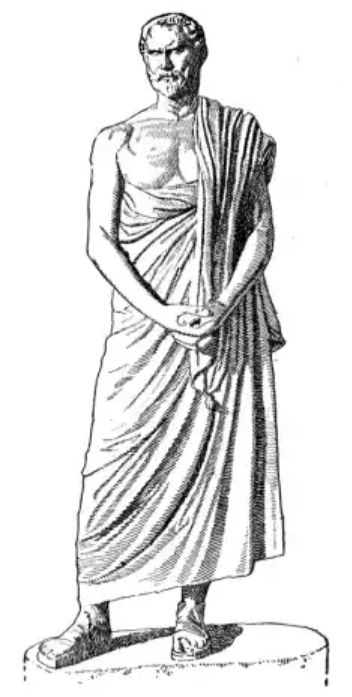 The word for garments is the Greek word
 himation
. This word is unfamiliar to us but in the ancient Greek civilization, they knew exactly what it was and what it meant. The himation was a large rectangular garment worn either as an outer cloak or on its own, was one of the most enduring garments within Greek society.30 The himation played a significant role in defining Greekness through its own means of simplicity. Contrasting to the highly ornamented clothing of foreigners, the himation was generally unadorned, symbolizing a restrained modesty.31 Elites favored opulent versions incorporating shellfish purple (Tyrian purple) from murex snails, achieved through labor-intensive boiling processes yielding minimal dye per shellfish, often combined with wool or silk linings to denote wealth and prestige.32 However, Jesus wanted the Laodicean's to wear a white, simple, himation that did not show off their wealth or prestige, but instead displayed their purity, holiness, righteousness, and redemption from sin.
The black wool of Laodicea produced some stunning dark-colored garments. The mineral water from Hierapolis helped lock the color dyes into white wool, so the color did not fade after multiple washes. But in this verse, Jesus told the church that they were naked and in need of white garments that had not been dyed, and that only he can provide. White is the most frequently mentioned color in the Bible. The color white often symbolizes purity, holiness, righteousness, and redemption from sin.33 Isaiah 1:18, Acts 3:19, and Revelation 7:17 state that the blood of Jesus washes our sin-stained garments, making them white as snow. Jesus wrote the letter to the Laodicean Christians who already had the white garments of salvation, so we are led to wonder why they needed to purchase more white garments and how to purchase them.
The question we'll delve into is why they needed to purchase white garments. If you think back to the Garden of Eden, clothing was the first thing that Adam felt they needed after he had sinned. After he sinned, he felt his nakedness and shame. After letting him ineffectively try to cover himself, God provided him with clothing. God took animal skins and clothed Adam and Eve. This act concealed the shame of his nakedness. The church at Laodicea stands accused of being shamefully naked. They had stopped worshipping God and were worshipping money, and in the process, spiritually took off the white clothing they received during salvation and stood naked before God. The lack of white clothing does not mean they removed their salvation; it simply means the clothing that symbolized their purity and righteousness was gone. All of their success and self-righteousness was nakedness in God's sight.
We now come back to the question of how to purchase white garments from Christ, but before we do that, there are a couple of terms that I need to define. Those terms are imputed righteousness and imparted righteousness. Imputed righteousness is the righteousness of Jesus Christ, credited to a person enabling him/her to be justified in the eyes of God. When we say that God imputes Christ's righteousness to us, it means that God thinks of Christ's righteousness as belonging to us, or regards it as belonging to us. He reckons it to our account.34 The process of reckoning is what we call salvation. Imparted righteousness is the righteousness of sanctification, wherein God causes the Christian to become more and more Christlike. It is a process where God makes us holy. God the Father sanctifies (1 Corinthians 1:30) by the Spirit (2 Thessalonians 2:13; 1 Peter 1:2) and in the name of Christ (1 Corinthians 6:11). Sanctification is a progressive work of God and man that makes us more and more free from sin and like Christ in our actual lives.35 Imparted righteousness is applied imputed righteousness, or to put in simpler terms; sanctification is applied justification. Justification by its very nature does not have a progressive character. Justification is God's declaration of righteousness (it is imputed). The focus of justification is the removal of the guilt of sin. The focus of sanctification is the healing of the dysfunctionality of sin (it is imparted). While God sanctifies by grace, Christians are responsible to appropriate God's grace by faith. Faith is the means (produces the results) of sanctifying grace
Now to the business of how to purchase white garments from Christ. It has everything to do with imparted righteousness. The white clothing we need to purchase from Christ is imparted righteousness. But just as any purchase requires something for something, Christ is expecting something from the Christian. We are to present ourselves as living sacrifices
(Romans 12:1). In the Old Testament, the sacrifice could not be slain until it had been presented to the priest. In the New Testament, a believer dies with Christ to live a new holy life in the power of Christ's resurrection and identification with Christ's suffering (Romans 6:1-11, Galatians 2:20; Philippians 3:8-10). Good deeds (Ephesians 2:10), godliness (1 Peter 1:15), Christ-likeness (1 Peter 2:21), and fulfilling the demands of the Law (Rom 8:4) are all part of the cost in purchasing white garments from Christ.)
18c … and eye salve to anoint your eyes so that you may see. Christ told the church (in verse 17) that they were blind, and in verse 18, instructed them to purchase eye salve. Although Laodicea produced the best eye salve in the ancient world, the Laodicean Christians were blind to their spiritual state. In the New Testament, eyes often represent spiritual discernment (Matthew 13:10-17, 1 John 2:11). Spiritual discernment is the ability to distinguish between truth and error. It is the foundation of wisdom. It can only come by the revelation of Jesus Christ to the believer. It must then be developed through training in righteousness (Hebrews 5:14) and prayer (Ephesians 6:18). Therefore, the Lord Jesus tells them to buy eye salve from Him to see their spiritual state. Hebrews 5:11-14 shows how the eye salve for spiritual discernment is applied. The writer speaks to those who had become "dull of hearing," meaning they had little to no spiritual discernment. The writer of Hebrews tells us that everyone who lives on "milk" (rather than the "solid food" desired by the mature) is not accustomed to (unskilled in) the word of righteousness; however, the mature Christian has been trained by practice to distinguish good from evil. The keys, according to this passage, are becoming skilled in the Word of God (by which we define righteousness) and "practice" (through which we gain experience).
The eye salve must be purchased, and it is expensive. So what does it cost to purchase eye salve from Christ? Time. You’re going to have to give him your time. You’re going to have to spend time reading the Bible to learn the truth, and by meditating on the Word, reinforce the truth. You’re going to have to spend time reading the Word, studying the Word, memorizing the Word, meditating on the Word, and obeying the Word. Your time in the Word should be, at a minimum, four times a week.36 The more time you give Christ to purchase this eye salve, the more results you will see. Giving time to Christ is what Christians must do to develop spiritual discernment. You must know the truth so well that, when the lies of the enemy appear, you can recognize them. By knowing and obeying the Word of God, you will be trained by constant practice to distinguish good from evil. You will know God’s character and will, and that is the heart of spiritual discernment – being able to distinguish the voice of God from the voice of the world. It is to have a sense of what is right and what is wrong. Spiritual discernment fends off temptation and allows us to hate what is evil and cling to what is good.
Revelation 3:19
Those whom I love, I reprove and discipline, so be zealous and repent.
19a Those whom I love (who are my friends), I reprove and discipline Jesus loves this church, or he would not have rebuked them. Now, why did I add in parentheses, ‘who are my friends’? The word for love used in this verse is not agape but phileo. There is a distinct difference between the two words. As you may know, agape is the highest form of unconditional, sacrificial love, but phileo, however, is a type of friendship love. Jesus' friendship with this church is so deep that he is willing to point out their problems. It takes a true friend to point out negative things in your life and then be willing to be part of the solution. Fortunately for us, Jesus is that friend. It is important to understand that Jesus does not call just anyone his friend. He was very careful about whom he called “friend.” Jesus never referred to anyone who was not his disciple as a friend. Even though Jesus spent time with sinners, he never called them friends. In John 14:14, Jesus said: “You are my friends if you do what I command you.” Had this church been filled with non-Christians, Jesus would not have called them friends. The fact that he calls them friends shows that he expects them to get their spiritual priorities straightened out and back on the right path.
The word reprove is not used very much in English anymore. The word “rebuke” may be a better choice due to its connotation of scolding and proving one to be in the wrong.37 Jesus is doing more than just telling the Laodiceans their faults; he is convicting them of their sin. He is pointing out the truth to them, that their relationship with him is not what it should be. So God will discipline them. Exactly how God will correct or chastise them is unknown. The basic idea behind discipline is correction or guidance, which corresponds with Hebrews 12:5-11, which explains that God's discipline proceeds from his love and seeks to develop righteousness in his people. God's discipline may be gentle persuasion to return to right behavior, or he may use punitive action if persuasion fails.
19b … so be zealous and repent. The word zealous is rarely used in English (outside of the Bible). We are, however, familiar with the concept of being passionate or enthusiastic about something. That is exactly what the word zealous portrays.38 The church is commanded to be earnest or have a passionate eagerness to repent. But this can only happen when we are in the right relationship with him. The only way to be in a right relationship with God is through forgiveness. What exactly is forgiveness? First of all, it begins with recognizing, with a heart-rending awareness, that we have defied God when we sin. Repentance comes from the heart and involves confessing from the heart. We cannot deny our sin or make excuses to justify it. Confession by itself is not repentance. Confession is the mind moving the lips; repentance moves the heart. A change of heart will follow honest confession.
Repentance is more than a feeling; it is a change in behavior. A change in behavior will follow true repentance. here are two terms I would like to point out: “attrition” and “contrition.” Attrition is regret for sin prompted by fear for oneself: “Oh, no. I got caught. What will happen to me?” Contrition, on the other hand, is regret for the sin committed against God’s love and regret for having grieved the Holy Spirit. The fruit of godly repentance is unmistakable: earnestness and a passion (zeal) to do what is right in the eyes of God. The essential element in real repentance is that we must come to God in humbleness to request his forgiveness. We must ask God for forgiveness and for strength to avoid sinning. Then we must take active, practical steps to avoid falling into sin. We must be determined to pursue purity and to do what pleases God (1 Thessalonians 1:9). For the Laodiceans, this meant forsaking whatever might perpetuate the lack of spirituality and unwarranted self-sufficiency in which they languished.f spirituality and unwarranted self-sufficiency in which they languished.
Revelation 3:20
Behold, I stand at the door and knock. If anyone hears my voice and opens the door, I will come in to him and eat with him, and he with me.
20a Behold, I stand at the door and knock … Have you ever been locked out of your own house? If you have, you can probably imagine what Jesus is experiencing. He's locked out of his own house. In the context of Revelation 3, then, Christ was standing at the door of the Laodicean church, eager to re-enter the congregation through the genuine repentance of its members. One of the most common errors associated with this verse is the notion that the “door” is the door to a sinner’s heart. Verse 20 is not a salvation message for non-Christians; it is a warning to Christians. Jesus is standing at the door, expecting his servants to open it. The Greek verb is in a perfect indicative active voice. What that means is that Jesus didn't simply state that he stands at the door and knocks, but that he has been standing for an implied long time, or even that his manifestation at and sudden knock on the door is the result of a long process.39 We have no idea how long Jesus had been knocking, waiting for someone, anyone, to let him in.
20b … if anyone hears my voice and opens the door … Why does the church not hear his voice? Why does the church not hear his knock? Are they so focused and preoccupied with prosperity that they cannot hear Christ's voice or hear his knock? Are they so busy doing "things" for Christ that they're too busy to open the door? It would appear so. The depressing part of this verse is the word if. If anyone hears My voice and opens the door. What happens if the church does not hear his voice and does not open the door? The possibility exists that no one will hear his voice, or open the door. The positive aspect is that if someone does hear his voice and does open the door, Jesus will come in. All it takes is one.
20c … I will come in to him and eat with him, and he with me. If anyone in the church hears Christ's voice and opens the door, he will come and dine with them. The word eat has the connotations of eating at a banquet.40 In ancient Greek and Jewish culture, the evening meal was a social event. It was important for them to eat with family and/or friends. Dinner was a time for everyone to catch up on the rest of the family's daily activities and on any friends who were in attendance. Jesus desires to come in, sit down at the table, and enjoy the food and company. He wants to be the friend that we invite over to dinner. He wants to be a friend we enjoy spending time with. He wants to hear about how our day went and share in our victories and sorrows. But we have to invite Him inside.
Revelation 3:21
The one who conquers, I will grant him to sit with me on my throne, as I also conquered and sat down with my Father on his throne.
21a The one who conquers. What does it mean to conquer? The word for conquer is also translated as “overcomer” in many versions of the Bible. The word doesn’t mean just to conquer or overcome, but also to be more than victorious.41 All you have to do is look at history to see that you can win a battle but lose the war. What Jesus is referring to is winning the battle and winning the war. However, we must be aware that conquering, or overcoming, is not a certainty but rather an aspiration each individual should pursue. It is a victory gained by an active faith fed through fellowship with the Lord.42 The Savior’s words are never to them (a collective group) who overcome but to him (the individual) who overcomes. Victory is not a collective right but an individual attainment. Clearly, the promises to the overcomers are rewards for obedience to the commands of the Lord to the Church.43
What was it the Laodiceans were supposed to conquer or overcome? It is important to keep this verse in context with the rest of the passage. Laodicea was a church that had not overcome sin but rather been overcome by sin. Instead of being victorious over temptation, temptation had been victorious over them. The church at Laodicea was not victorious, but Christ had not yet given up on them. He encouraged them to overcome just as He did. This begs the question: How did Jesus overcome?
1. Jesus' life was controlled by God's will: “Not my will, but Yours, be done.” When Jesus came into the world, He declared, “God, You have given Me a body, and I have come to do Your will.” (Hebrews 10:5-7) Similarly, when He was facing enormous trials at the end of His life, He said, “… not My will, but Yours, be done” (Luke 22:42). Due to the sin nature, “my will” almost always runs counter to God's will. It covers a myriad of areas, including pride, impatience, selfishness, unrighteousness, irritation, laziness, vanity, complaining, sexual impurity, unbelief, discouragement, envy, greed, and ingratitude. As a man, Jesus also had this self-will and was tempted, but His firm resolve from the very start was, “Not My will, but Yours!” For us to overcome as He overcame, we need to make that same decision and faithfully stick to it, no matter what happens or how we feel.
2. Jesus lived a life of humility. “Let this mind be in you which was also in Christ Jesus, who, … being found in appearance as a man, He humbled Himself and became obedient to the point of death, even the death of the cross.” Philippians 2:5-8. Jesus was in Heaven with God, but voluntarily became a man for our sakes. You would have thought that this was the ultimate act of humility. But it's written that it was as a man that He humbled Himself, and was obedient. His obedience stemmed from the fact that, as a man, He had a self-will in agreement with the Father's. In the situations of daily life, when tempted by impatience, irritation, envy, discouragement, etc. He humbled Himself to the Father's will. He had to take up a battle against the sin, and carry out His pledge: “Not My will, but Yours, be done!”
3. Jesus knew how to use God's grace. “For we do not have a High Priest who cannot sympathize with our weaknesses, but one who has been tempted in all things as we are, yet without sin.” Hebrews 4:15 NASB. Before He left the earth, Jesus promised His disciples that He would send them the Holy Spirit, the Comforter, who would guide them to the truth (John 14:16-17, 26; John 15:26). “Let us, therefore, come boldly to the throne of grace, that we may obtain mercy and find grace to help in time of need.” Hebrews 4:16. What is the time of need? The time of need is when temptation comes, when we see and feel the sin in our flesh, when we struggle to keep ourselves from sinning. If we pray for help as Jesus did, with humility and desperation to gain victory, then we will get help. The Holy Spirit will come and show us the way out. If we are humble and willing to obey, He will give us the strength and resolve we need to endure in the battle. He has given us God’s Word as a guide, help, and a weapon.
4. Jesus used scripture as a weapon againsy temptation. God’s Word is a sword. (Ephesians 6:17 Hebrews 4:12). It is the absolute truth and a powerful weapon against temptation and sin. In Matthew 4:1-11, during Jesus' temptations, His reply always started with, “it is written….” But Jesus didn’t only quote the Word; He had authority when He used God’s Word because He also lived by it. In John 1:14, we read the astonishing words that “the Word became flesh and dwelt among us.” Jesus could be described as the Word personified. His entire life was a fulfillment of God's Word, and thereby, God’s will. The Bible is the weapon God has given us; words to use against Satan's deceit like Jesus did, words that show us what to do, words of comfort. The Bible exposes Satan's lies and deceit and is the tool to overcome all the sinful tendencies in our flesh.
5. Suffer in the flesh, cease from sin. “Therefore, since Christ suffered in the flesh, arm yourselves also with the same mind, for he who has suffered in the flesh has ceased from sin, that he no longer should live the rest of his time in the flesh for the lusts of men, but for the will of God.” 1 Peter 4:1-2. This suffering was not the physical suffering on the cross of Calvary. It was the suffering of the cross He used daily, when He said “No” to His own will, the sin in His flesh, even when it bombarded Him incessantly with its demands and deceitful attraction. The sin in His nature had received its death sentence when He said, “Your will be done, God.” As disciples who follow Jesus, we must learn to hate the sin in our own life, deny ourselves, and take up our cross. (Luke 9:23, Luke 14:26) It costs us something. It costs our will. It costs our life. We must pray and cry out to God, and our lust for sin has to feel the pain of being denied. On the “cross daily,” they suffer and die. While we may never be free from temptation and sin in this lifetime, we can still be victorious and overcome.
21b … I will grant him to sit with me on my throne, as I also conquered and sat down with my Father on his throne. The promise in this verse is that the church will reign with Christ if they overcome. That the Christians will co-reign with Christ (sitting with Him on His throne) is stated in the New Testament on numerous occasions (Matthew 19:28; Luke 22:30; 1 Corinthians 6:1-3, 2 Timothy 2:12). The reward here seems to be one of sharing royal honor, victory, and authority with Christ in His future kingdom. Jesus was obedient and faithful, even to the point of death (John 12:27-28). He was diligent and committed to the will of God the Father (John 4:34). He humbled Himself so that He could achieve His purpose in God's plan by putting God's will before His own. Therefore God exalted Him and gave Him his own thrown (Philippians 2:5-11). Christ calls out to us, letting us know that because He overcame, we can also overcome. It is a message of hope and victory. It is through our relationship and identification with Christ and His work, and our faithfulness in the conflict with sin as we draw upon Christ, that we get to share in His reign as a reward for faithful service. This promise is amazing because, whenever we do overcome in the battles of life, it is always through Him.
Revelation 3:22
He who has an ear, let him hear what the Spirit says to the churches.
The phrase “who has an ear” is used throughout the Bible, starting with Deuteronomy 29:4. Moses was rebuking the rebellious Israelites by saying, “But to this day, the LORD has not given you a heart to understand or eyes to see or ears to hear.” He was not referring to physical hearing, but to those who may hear the commands of the Lord but who lacked comprehension and desire to act upon those words (Jeremiah 5:21 Ezekiel 12:2). Those who do not have "ears to hear" are spiritually dead and cannot obey God until they respond to His work in their hearts (John 6:65; Romans 11:8). The act of hearing implied obedience. To hear is to obey.
The phrase who has an ear qualifies everyone who will listen and obey. It is a phrase Jesus often used when speaking in parables. Whenever Christ says, He who has an ear, let him hear, He calls for people to pay careful heed. It's another way of saying, “Listen up! Pay close attention! What I said was important!” Those who have ears to hear allow the Word to bear fruit to the glory of God. It is up to the hearer to decide whether to take the Word seriously and try to understand and obey it. Christ calls the church to pay close attention and seek God's wisdom regarding the written Word. Only a few are willing; the rest have ears but do not have “ears to hear” (Matthew 7:13–14, 24–27).
Summary
Jesus did not commend the church in Laodicea for anything. Sadly, nothing they did was noteworthy. They were financially rich while at the same time spiritually bankrupt. They saw themselves as self-sufficient with no need of God and became spiritually complacent. They saw their wealth as providing for everything they needed. The cause of Laodicea’s lukewarmness was linked directly to their wealth and prosperity. That warning is one that we should heed. There is nothing wrong with having wealth as long as we use it to bless others and expand God's kingdom for his glory. Jesus wanted access into the hearts of the Laodicean believers. Let’s make sure we give him access to ours.
Would you like information on how to become a Christian?
Touch the button below for Steps to Salvation
✝ Salvation
Have a question or comment about “Laodicea?”
Touch the button below to send Steven P. Wickstrom an e-mail:
E-mail
To print “Laodicea” click the button below to download the PDF file.
Print
Footnotes
[1] Izabela Sobota-Miszczak, “Laodicea on the Lycus,” Turkish Archaeological News, accessed April 6, 2026, https://turkisharchaeonews.net/site/laodicea-lycus. ↩
[2] Everett C. Blake and Edmonds Anna G., Biblical Sites in Turkey (Turkey: Redhouse, 1994), 139-40. ↩
[3] Izabela Sobota-Miszczak, “Laodicea On the Lycus,” Turkish Archaeological News, October 28, 2018, https://turkisharchaeonews.net/site/laodicea-lycus. ↩
[4] W. M. Ramsay, W.M. Ramsay: Letters to the Seven Churches of Asia - Christian Classics Ethereal Library, accessed April 6, 2026, https://ccel.org/ccel/ramsay/letters/letters.xxxi.html. ↩
[5] Izabela Sobota-Miszczak, “Laodicea On the Lycus,” Turkish Archaeological News, October 28, 2018, https://turkisharchaeonews.net/site/laodicea-lycus. ↩
[6] Izabela Sobota-Miszczak, “Hierapolis,” Turkish Archaeological News, accessed April 6, 2026, https://turkisharchaeonews.net/site/hierapolis. ↩
[7] Teachers such as John MacAurthur, and others. Do a simple Google search and see for yourself. ↩
[8] Ray Burns, “I Was Wrong about the Lukewarm Church in Revelation 3:14-22,” Onward in the Faith, accessed April 13, 2026, https://onwardinthefaith.com/i-was-wrong-about-the-lukewarm-church-in-revelation-314-22/. ↩
[9] Moises Silva, New International Dictionary of New Testament Theology and Exegesis, 2nd ed. (Grand Rapids, MI: Zondervan, 2014), 1:120. ↩
[10] William D. Mounce, Basics of Biblical Greek Grammar, ed. Verlyn D. Verbrugge, 3rd ed. (Grand Rapids, MI: Zondervan, 2009), 12. ↩
[11] Emily Snow, “Why Ancient Greeks Wrote without Spaces or Punctuation,” TheCollector, accessed April 3, 2026, https://www.thecollector.com/scriptio-continua-ancient-greek-writing/. ↩
[12] Warren Baker and Eugene E. Carpenter, The Complete Word Study Dictionary: Old Testament, Word Study Series (Chattanooga, Tenn.: AMG Publishers, 2003), 540. ↩
[13] Chaim Bentorah, “Hebrew Word Study – Faithfulness – Aman אמן Aleph Mem Nun,” Chaim Bentorah, accessed April 6, 2026, https://www.chaimbentorah.com/2021/01/hebrew-word-study-faithfulness-aman-%D7%90%D7%9E%D7%9F-aleph-mem-nun/. ↩
[14] Spiros Zodhiates, The Complete Word Study Dictionary: New Testament (Iowa Falls, IA: World Bible Publishers, ©1992), 1164. ↩
[15] Ibid., pg 112. ↩
[16] W E. Vine, Vine's Complete Expository Dictionary of Old and New Testament Words: With Topical Index (Nashville: T. Nelson, ©1996), 680. ↩
[17] J. H. Thayer, Greek-English Lexicon of the New Testament: Being Grimm's Wilke's Clavis Novi Testamenti. Hendrickson Pub., 1999. ↩
[18] Moen, Skip. “Paycheck.” Hebrew Word Study | Skip Moen. Last modified March 11, 2012. Accessed March 12, 2026. https://skipmoen.com/2012/03/paycheck/. ↩
[19] Bill Mounce, “Ἔργον,” Billmounce.Com, accessed December 15, 2025, https://www.billmounce.com/greek-dictionary/ergon. ↩
[20] John Tweeddale, “Good Works and the Christian Life,” Ligonier Ministries, accessed December 15, 2025, https://learn.ligonier.org/articles/good-works-christian-life. ↩
[21] W E. Vine, Vine's Complete Expository Dictionary of Old and New Testament Words: With Topical Index (Nashville: T. Nelson, 1996), 108. ↩
[22] Spiros Zodhiates, The Complete Word Study Dictionary: New Testament (Iowa Falls, IA: World Bible Publishers, ©1992), 699. ↩
[23] Philip Chrysopoulos, “The History of Wine in Ancient Greece,” GreekReporter.Com, accessed April 7, 2026, https://greekreporter.com/2025/06/06/wine-ancient-greece/. ↩
[24] Spiros Zodhiates, The Complete Word Study Dictionary: New Testament (Iowa Falls, IA: World Bible Publishers, ©1992), 1477. ↩
[25] Joseph Henry Thayer, Thayer’s Greek-English Lexicon of the New Testament: Coded with Strong’s Concordance Numbers, ed. Carl Ludwig Wilibald Grimm and Christian Gottlob Wilke (Peabody, MA: Hendrickson, 2017), 207. ↩
[26] Izabela Sobota-Miszczak, “Laodicea On the Lycus,” Turkish Archaeological News, October 28, 2018, https://turkisharchaeonews.net/site/laodicea-lycus. ↩
[27] Editorial Staff, “Πλουτος: Abarim Publications Theological Dictionary (New Testament Greek),” Abarim Publications, n.d., accessed April 8, 2026, https://www.abarim-publications.com/DictionaryG/p/p-l-o-u-t-o-sfin.html. ↩
[28] Grant Richison, “Revelation 3:17,” Bible Exposition Commentary, accessed April 8, 2026, https://versebyversecommentary.com/1998/11/24/revelation-317/. ↩
[29] Vee Enne, “Gold Smelting Process,” Sciencing, April 24, 2017, https://sciencing.com/gold-smelting-process-5453916.html. ↩ ↩
[30] Lyndsay Turner, “The Himation: Modesty, Status and Agency in Ancient Greek Society,” Dress and Adornment in Ancient Greece, September 19, 2025, accessed April 13, 2026, https://ecampusontario.pressbooks.pub/dressandadornmentancientgreece/chapter/himation-and-veiling/. ↩ ↩
[31] Editorial Staff, “Fashion, Costume, and Culture: Clothing, Headwear, Body Decorations, and Footwear through the Ages”. . Encyclopedia.Com. 2 Apr. 2026 .,” Encyclopedia.Com, May 11, 2018, accessed April 13, 2026, https://www.encyclopedia.com/sports-and-everyday-life/fashion-and-clothing/clothing-jewelry-and-personal-adornment/himation. ↩ ↩
[32] Editorial Staff, “Himation,” Grokipedia, accessed April 13, 2026, https://grokipedia.com/page/Himation. ↩ ↩
[33] Brian G. Chilton, “Reference Guide to the Biblical Symbolism of Colors,” CrossExamined, November 14, 2024, accessed April 14, 2026, https://crossexamined.org/reference-guide-to-the-biblical-symbolism-of-colors/. ↩ ↩
[34] Wayne A. Grudem, Systematic Theology: An Introduction to Biblical Doctrine (Leicester, England: Inter-Varsity Press, 1994), 726. ↩ ↩
[35] Ibid., pg. 746. ↩ ↩
[36] Dr. Arnie Cole and Dr. Oamela Ovwigho, “The Power of 4 Effect,” Back to the Bible, https://www.backtothebible.org/research. ↩
[37] Spiros Zodhiates, The Complete Word Study Dictionary: New Testament (Iowa Falls, IA: World Bible Publishers, ©1992), 1088. ↩
[38] Spiros Zodhiates, The Complete Word Study Dictionary: New Testament (Iowa Falls, IA: World Bible Publishers, ©1992), 699. ↩
[39] Editorial Staff, “The Verb Ιστημι: The Most Potent Verb in the New Testament,” Abarim Publications, accessed April 14, 2026, https://www.abarim-publications.com/DictionaryG/i/i-s-t-et-m-i.html. ↩
[40] Spiros Zodhiates, The Complete Word Study Dictionary: New Testament (Iowa Falls, IA: World Bible Publishers, ©1992), 402. ↩
[41] Verlyn D. Verbrugge, New International Dictionary of New Testament Theology (Grand Rapids, MI: Zondervan, 2004), 387. ↩
[42] J. Hampton Keithley, “Revelation - Appendix 3: Who Are the Overcomers?,” Revelation - Appendix 3: Who Are the Overcomers? | Bible.org (Bible.org, February 2, 2009), last modified February 2, 2009, https://bible.org/seriespage/revelation-appendix-3-who-are-overcomers. ↩
[43] Zane C. Hodges, Grace in Eclipse, Redencion Viva, Dallas, TX, 1987, p. 108-109. ↩
© 15 Apr 2026 by Steven P. Wickstrom, all rights reserved. Click the button below for more information about the copyright.